In the sprawling world of Greek mythology, Naiads are the captivating spirits of fresh water. They are deeply, almost mystically, tied to the life force of springs, rivers, and lakes. Think of them not just as living in the water, but as the very essence of their water source—its soul and its guardian. Their stories are woven throughout ancient legends, painting them as both beautiful givers of life and formidable protectors.
Your Introduction to the World of Naiads
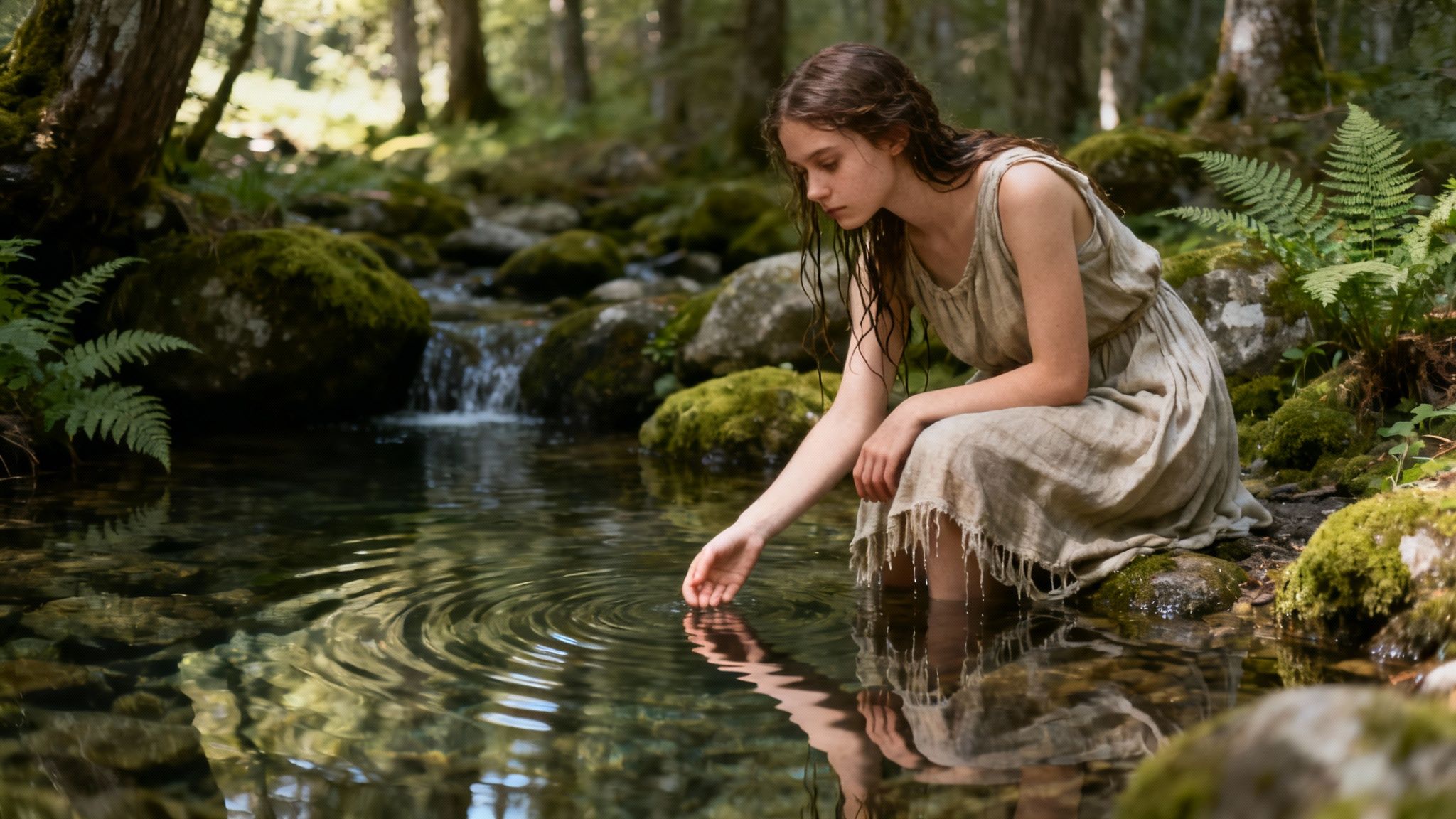
Imagine walking through an ancient, moss-covered forest and stumbling upon a hidden spring. The water is crystal clear, and the air hums with a quiet, watchful energy. According to Greek myth, you've just entered the domain of a Naiad—a youthful and elegant nymph whose very existence is inseparable from the water she calls home.
These weren't just minor spirits. The ancient Greeks saw them as minor goddesses who held real power over their surroundings. A Naiad’s presence could mean the difference between a lush, fertile land and a dry, barren wasteland.
For a quick reference, here’s a snapshot of what defines a Naiad.
Naiads at a Glance
| Attribute | Description |
|---|---|
| Mythology | Ancient Greek & Roman |
| Domain | Freshwater: springs, rivers, streams, fountains, lakes |
| Nature | Life-giving, protective, often benevolent but sometimes dangerous |
| Lifespan | Extremely long-lived, but mortal; their life is tied to their water source |
| Key Role | Guardians and personifications of a specific body of water |
This table just scratches the surface, but it gives you a great starting point for understanding these fascinating beings.
The Essence of Flowing Water
At their core, Naiads are mythological freshwater nymphs whose name comes from Greek root words meaning "to flow" or "flowing water." This gets to the heart of their identity, highlighting their deep bond with moving water. While grand river gods might embody entire river systems, a Naiad was tied to a more specific, localized spot—a single spring, a particular stream, or a quiet pond. For a bit more on their origins, you can check out the rundown on Fiveable.me.
This direct line to their home was both their greatest strength and their greatest vulnerability. A Naiad's health and vitality perfectly mirrored her spring or river. If her waters flourished, so did she.
A Naiad is more than a creature living in the water; she is the water. Her laughter is the babbling of a brook, and her anger is the rush of a sudden torrent.
This is your gateway into their world. Once you grasp their fundamental nature—as beautiful, powerful, and sometimes dangerous guardians—you're ready to dive deeper into their specific types, powers, and legendary stories. They could offer blessings of fertility and healing, but they would fiercely defend their sacred homes from anyone who showed disrespect.
Getting to Know the Naiads: Origins and Types
To really understand Naiads, you have to look at their family tree. They weren't like the Olympian gods living on a mountaintop. Instead, Naiads had more humble beginnings, often born right out of the landscape itself. Their ancestry connects back to ancient, elemental deities, making them part of the very fabric of the Greek world.
Many myths say Naiads were the daughters of the Potamoi—the great river gods who were the living embodiments of the world's major waterways. As sons of the Titans Oceanus and Tethys, these powerful gods fathered countless nymphs. Each Naiad inherited a small piece of her father's divine connection to water. Other stories name Zeus, king of the gods, as their father, which shows how respected they were.
This divine parentage forged an unbreakable link between a Naiad and her home. She wasn't just a guardian; she was its life force. The connection was so total that her own fate was tied to her water source. If her spring dried up or became polluted, she would fade away and eventually die.
This symbiotic relationship meant a Naiad's very existence was a mirror of her environment's health. The well-being of the nymph and nature were one and the same, making her the ultimate environmental guardian of ancient myth.
The Different Classes of Naiads
While all Naiads are spirits of fresh water, they aren't all the same. The ancient Greeks loved to organize and classify everything, and they sorted these water nymphs based on the specific type of water they inhabited. Understanding these categories helps us navigate their world and see the unique roles each group played.
Think of it this way: just as a forest has many different kinds of trees, the world of fresh water had several distinct types of Naiads. Learning about their domains reveals the incredible detail of Greek mythology, where every stream and fountain could have its own spirit.
A Closer Look at Their Domains
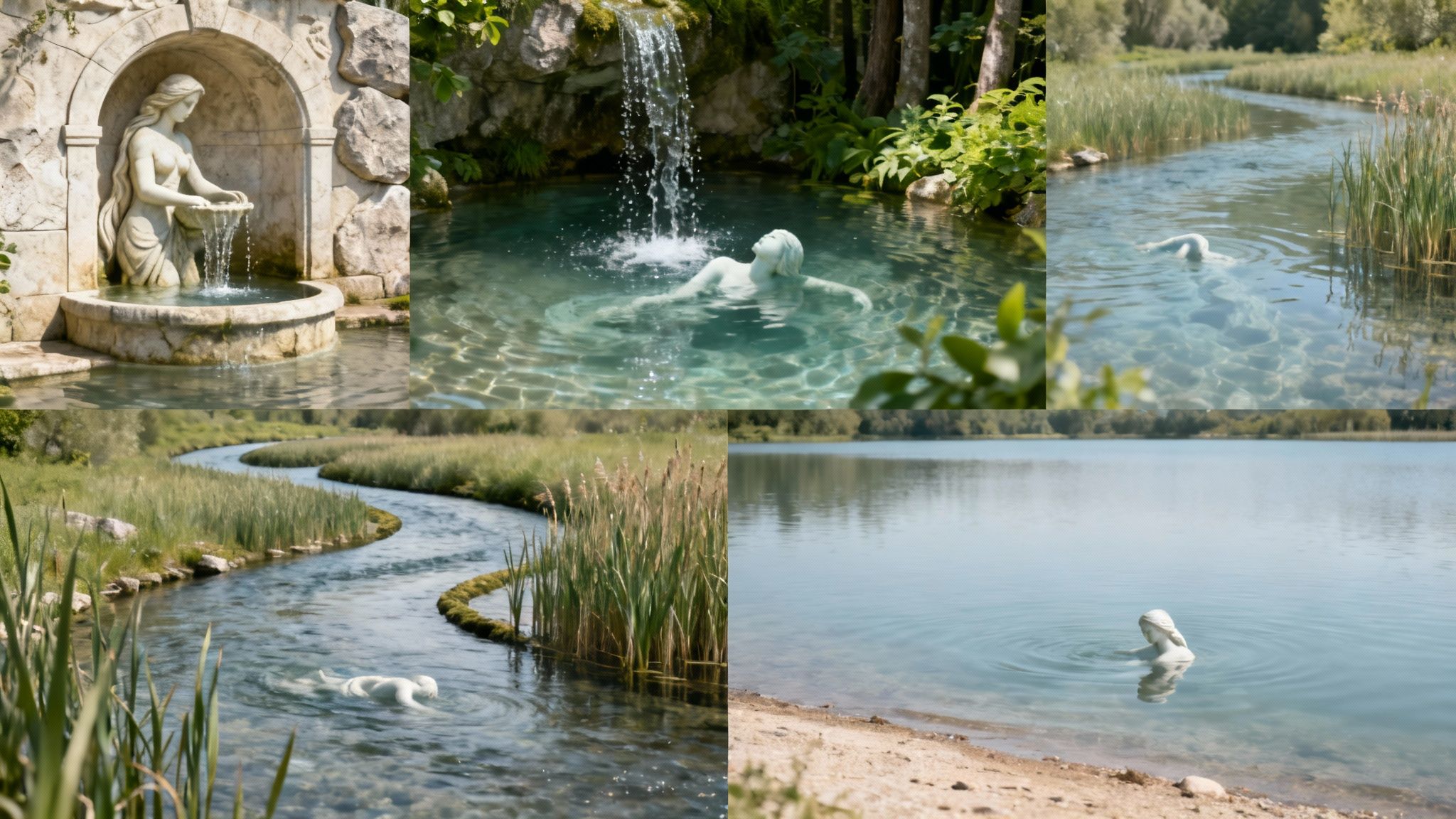
To make sense of it all, the Greeks broke Naiads down into a few main groups, each with its own special territory.
- Crinaeae (Fountains): These were the nymphs of fountains and wells. You'd often find them in sacred groves or even inside cities, and their waters were considered incredibly pure—sometimes used for special rituals.
- Pegaeae (Springs): Living in natural springs, the Pegaeae guarded the very sources of rivers and lakes. Their waters were often thought to have healing or prophetic powers, turning their homes into important spiritual sites.
- Potameides (Rivers): These were the nymphs of flowing rivers and streams. They were energetic, a bit wild, and embodied the constant, powerful motion of a river's current.
- Limnades (Lakes): The Limnades were the spirits of still waters like lakes, ponds, and marshes. They were usually seen as more peaceful than their river-dwelling cousins, but their calm waters could hide dangers for unwary mortals.
Exploring the Powers and Personalities of Naiads
Beyond being simple water spirits, what were Naiads really like? Their personalities were as unpredictable as a river's current, shifting from calm and helpful one moment to turbulent and deadly the next. This dual nature makes them some of the most compelling figures in Greek mythology.
On one hand, Naiads were seen as gentle, life-giving forces. People believed their waters held special powers that could heal the sick, inspire poets, and even grant visions of the future to those who drank from their springs. Farmers would pray to them, hoping the Naiads might bless their fields with rich soil and ensure a bountiful harvest.
But that gentle side came with a fiercely possessive streak. They were the ultimate guardians of their homes, and you did not want to get on their bad side.
Guardians with a Dangerous Streak
A Naiad’s protection over her spring or stream was absolute. Any mortal who disrespected her sacred space—whether by polluting the water or simply acting arrogant nearby—could face a terrifying end. The myths are filled with stories of Naiads whose jealousy and rage led them to drag unsuspecting humans into a watery grave, never to be seen again.
Their personalities were a complex bundle of contradictions:
- Benevolent Healers: They offered cures and blessings to those who approached with proper respect.
- Fierce Protectors: They would defend their homes with lethal force against any perceived threat or insult.
- Captivatingly Beautiful: Their enchanting looks could mesmerize gods and mortals alike, often leading to complicated romances and tragic tales.
This mix of traits meant you never quite knew what you were getting into when approaching a Naiad’s waters. It was always a gamble, balancing the hope of a divine gift against the fear of a deadly curse.
A Naiad’s dual nature perfectly mirrors the dual nature of water itself—it’s essential for all life, but it also has the raw power to destroy. They embody both the serene beauty of a quiet pond and the unstoppable force of a flash flood.
Supernatural Abilities
To protect their homes and enforce their will, Naiads had a range of supernatural powers at their disposal. Their most famous attribute was their unearthly beauty, which was so potent it could drive mortals mad with desire and even catch the eye of powerful gods like Zeus and Apollo.
But they were more than just beautiful faces. Many were gifted with the power of prophecy, able to see glimpses of the future in the ripples of their water. They could also shapeshift, changing their form to move through the world, though they usually preferred their graceful, human-like appearance. This deep connection to their environment gave them an intuitive understanding of the land, its plants, and its creatures, making them true embodiments of the wild, untamed places they called home. Their powers weren't just magical; they were an extension of nature's own life force.
How Naiads Compare to Other Water Spirits
The world of mythology is swimming with water spirits, and it’s easy to get them mixed up. While a mermaid from a fairy tale and a Naiad from a Greek myth both live in the water, they are vastly different beings. Pinning down these differences is the key to understanding the unique and vital role Naiads played as the spirits of fresh water.
Naiads are intrinsically tied to specific, life-giving sources of fresh water, like springs, rivers, and fountains. This deep connection to their home turf is what separates them from their saltwater cousins in Greek lore, who ruled over much larger domains. The crucial distinction is where they live.
This illustration shows the dual nature of a Naiad's personality—how she could be benevolent, malevolent, or captivating depending on the situation.
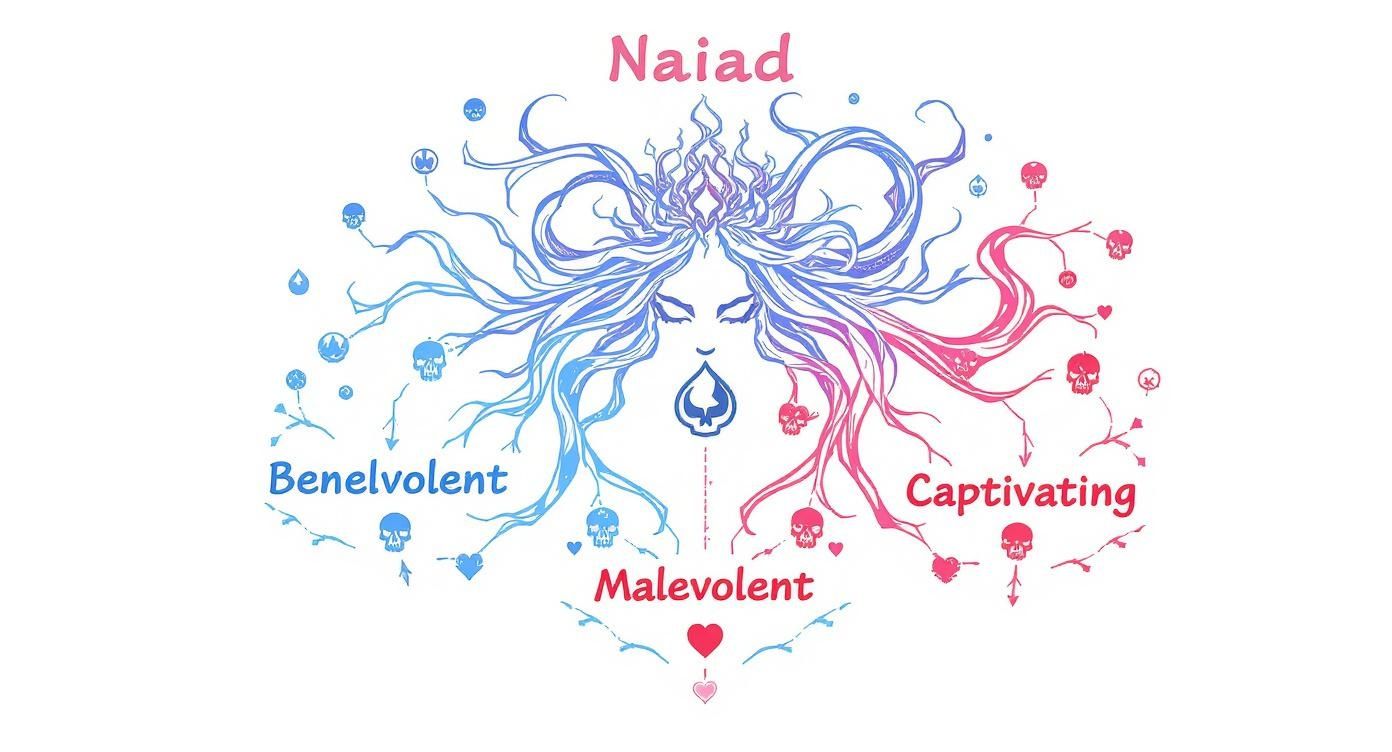
Their temperament was often as unpredictable as water itself. One moment, they could be calm and healing; the next, fierce and dangerous.
Greek Nymphs of the Water
Even within Greek mythology, you’ll find several types of water nymphs. Each group had its own territory and purpose, creating a clear hierarchy that stretched from the tiniest spring all the way to the vast, open ocean.
To help keep them straight, here’s a quick comparison of the major types of Greek water nymphs.
A Comparison of Greek Water Nymphs
| Nymph Type | Domain | Key Characteristics |
|---|---|---|
| Naiads | Freshwater (rivers, springs, wells) | Localized, tied to a single source; can be helpful or deadly |
| Nereids | The Mediterranean Sea | Daughters of Nereus; often seen as helpers to sailors |
| Oceanids | The world's oceans and major seas | Daughters of the Titan Oceanus; powerful, global scale |
This table makes it clear that while all are water spirits, their power and influence were tied directly to the scale of their domain.
A simple way to remember it is to think about scope.
A Naiad is like the spirit of your local creek, a Nereid is the spirit of the coastal sea, and an Oceanid is the spirit of the entire Atlantic Ocean.
Mermaids and Sirens
When most people think of water spirits, mermaids and Sirens often come to mind first. But they’re quite distinct from Naiads. Mermaids, with their iconic fish-like tails, come from broader European folklore and aren't specifically from Greek mythology. Their stories usually focus on their hybrid appearance and a longing for the human world.
Sirens, on the other hand, were terrifying figures in Greek myths, infamous for luring sailors to their deaths with their irresistible songs. While they lived near the sea, their defining feature was their deadly voice, not a connection to a specific body of water. A Naiad’s power comes from her water; a Siren’s comes from her song.
Legendary Naiads and Their Famous Stories
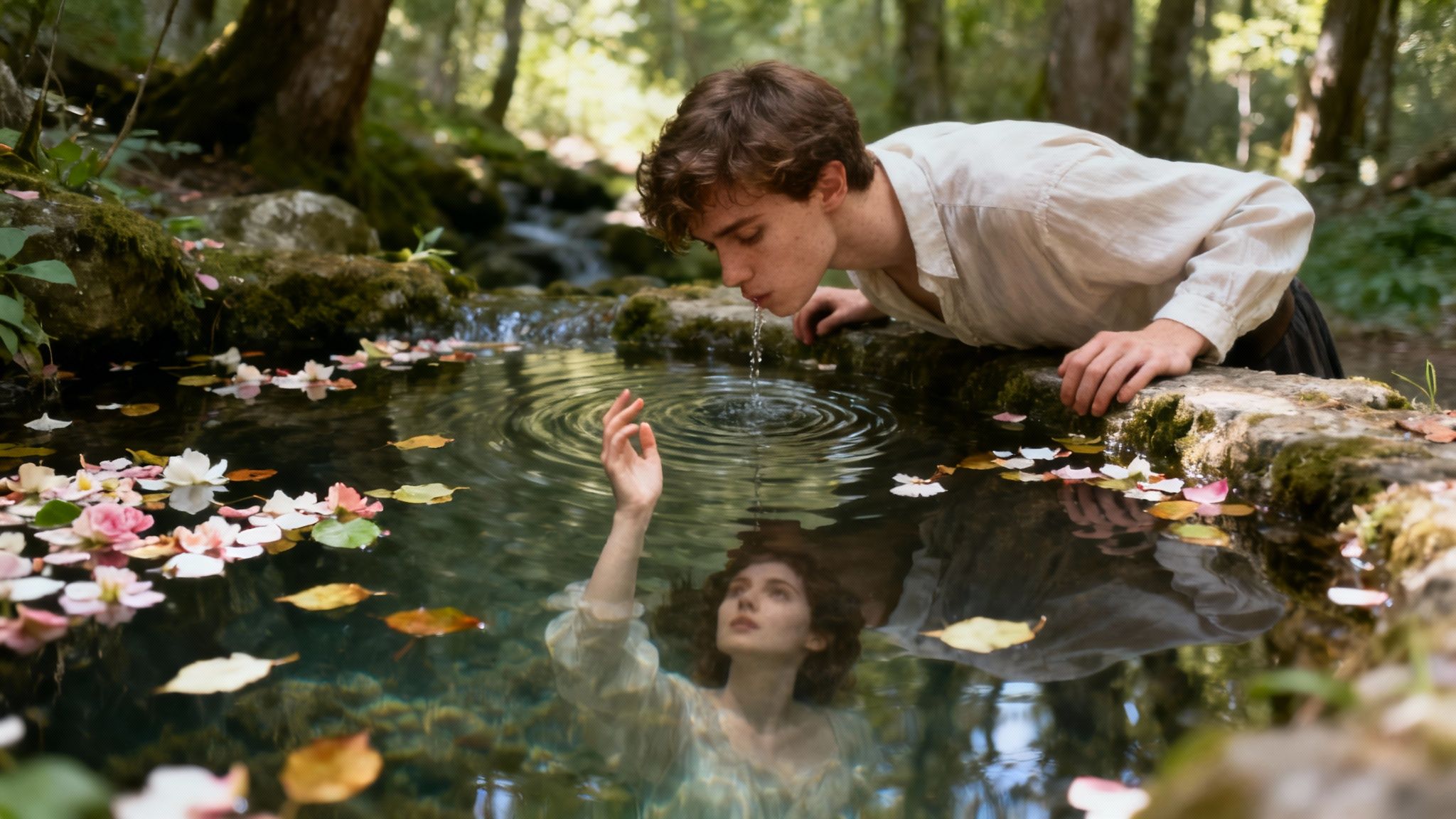
The best way to truly grasp the nature of Naiads is to dive into the stories the ancient Greeks told about them. These aren't just simple fairy tales; they're dramatic, often intense, accounts that reveal the power, passion, and sometimes the danger these water spirits represented. They show Naiads as living, breathing characters whose actions could change the lives of mortals and even gods forever.
Think of these stories as cautionary tales about the wild beauty of nature. They drive home a core theme in Greek mythology: the spirits of the natural world are powerful forces, and you enter their domain without respect at your own peril. The stories of Hylas and Salmacis are two of the most unforgettable examples of what could happen.
The Tragic Disappearance of Hylas
One of the most famous and chilling stories features a young man named Hylas. He was a companion to the hero Heracles, sailing with the legendary Argonauts. Hylas was known for his incredible beauty, which, as it turned out, was his undoing.
While fetching water from a spring on the island of Cios, he knelt by the water's edge. That spring happened to be home to a group of Naiads. The moment they saw him, they were utterly captivated—overcome by an immediate, desperate desire to possess him. In a flash, they reached up from the depths and pulled him under, silencing his cries before anyone could help. Despite Heracles' frantic search, Hylas was never seen again, spirited away to live forever in the Naiads’ watery home.
This myth is a perfect snapshot of the dangerous allure of the Naiads. They weren't being evil, not in a human sense. They were acting on a primal, overwhelming enchantment. It’s a haunting reminder that their love could be just as deadly as their anger.
The tale of Hylas shows that a Naiad's love could be just as deadly as her wrath. Their possessiveness over what they desired—whether their home or a beautiful mortal—was absolute and often tragic for those who caught their eye.
The All-Consuming Love of Salmacis
Another intense story is that of Salmacis, a Naiad who fell hopelessly in love with Hermaphroditus, the stunningly handsome son of Hermes and Aphrodite. When the young man stopped to bathe in her pool, Salmacis appeared and declared her love, but he rejected her.
Undeterred, Salmacis hid and waited for him to re-enter the water. The moment he did, she leaped out and wrapped herself around him, praying to the gods that they would never be parted. The gods heard her plea and granted it in the most literal way possible: they fused the two of them into a single being with both male and female characteristics.
The story of Salmacis shows just how passionate and relentless a Naiad could be. Her love was so all-consuming that it literally reshaped reality, forever changing both herself and the one she adored.
Lilaea and the Oracle of Delphi
But not all Naiads were caught up in tragic love stories. Some held incredible spiritual power. Take Lilaea, a Naiad whose spring was said to be a source of the great Cephissus river.
Her connection to a major river already gave her importance, but her real claim to fame was her link to the Oracle at Delphi, the most sacred site in ancient Greece. It was believed that people could learn their futures by tossing offerings into her spring. The way the items floated, sank, or swirled in the water was read as a direct message from the gods. This made Lilaea a vital link between the human world and the divine.
The Enduring Legacy of Naiads in Modern Culture
Even though the ancient temples are now ruins, the spirits of the Naiads are anything but forgotten. These timeless figures have flowed from Greek mythology into the books, films, and video games we love today. It’s a testament to their lasting appeal.
Their unique blend of beauty, danger, and a deep, primal connection to nature makes them compelling characters for modern fantasy. Storytellers keep finding new ways to tap into that mysterious allure, reimagining Naiads for new audiences. Once you know what to look for, you’ll start seeing their influence everywhere.
Naiads in Popular Media
One of the best-known examples is Rick Riordan's Percy Jackson & The Olympians series. The Naiads living in Camp Half-Blood's canoe lake aren't just background scenery; they’re lively, playful, and sometimes mischievous nature spirits who interact with the demigod campers. Riordan brings the myth to life in a setting millions of readers adore.
Their role in such a beloved series shows just how adaptable these spirits are. They aren’t historical footnotes; they’re active players in a massive modern fantasy world.
The reappearance of Naiads in modern stories like Percy Jackson demonstrates a key principle of mythology: the best stories are timeless. They can be retold and reshaped to resonate with any generation, proving that the core ideas of nature, magic, and mystery never go out of style.
Spotting Their Influence
Beyond direct name-drops, the Naiad archetype—the beautiful, sometimes dangerous female spirit tied to a specific natural spot—is everywhere in fantasy. It’s a classic trope for a reason.
You can find echoes of the Naiad in places like:
- Video Games: Many fantasy games feature water-based elementals or mystical guardians of sacred springs. They owe a clear debt to the Naiads of myth.
- Fantasy Literature: Countless books feature a character who is the living embodiment of a river or an enchanted lake. That’s the Naiad's core concept at work.
- Film and Animation: Look for magical beings who protect pristine natural areas, often using water-based powers to defend their homes from those who would harm them.
These modern takes keep the spirit of the Naiad alive, ensuring their legacy continues to inspire wonder and adventure for years to come.
Your Top Questions About Naiads, Answered
As we've journeyed through the world of Greek myths, a few common questions always seem to pop up about Naiads. Let's tackle them head-on, clearing up the lingering mysteries so you can walk away with a solid picture of these fascinating water spirits.
Here are straightforward answers to what people most often wonder.
Are Naiads immortal like the Greek gods?
Not exactly. While they were incredibly long-lived—often for thousands of years—they weren't truly immortal like Zeus or Athena. A Naiad's life force was completely and magically bound to her specific spring, river, or lake.
This was their greatest strength and their greatest vulnerability. If her spring dried up, her river was rerouted, or her lake became polluted, the Naiad would sicken and eventually fade away. This deep connection makes them powerful guardians but also incredibly fragile, their fate tied directly to the health of their home.
A Naiad's mortality is a powerful mythological metaphor. It’s a timeless reminder of how delicate ecosystems are, showing that the life of the spirit and the life of the water are truly one and the same.
Were all Naiads friendly to humans?
Definitely not. It's easy to picture them as purely helpful figures offering blessings and healing waters, and many myths do show them that way. But they could also be terrifyingly dangerous.
Naiads were fiercely protective of their homes. They had no problem punishing mortals who polluted their waters or trespassed without showing proper respect. Plenty of myths tell stories of them dragging arrogant or careless people to a watery grave. Their moods were as changeable as water itself—perfectly calm one moment, a deadly undertow the next.
Could Naiads leave their body of water?
Yes, but only for short periods and never for very long. A Naiad could walk on land, perhaps wandering into a nearby meadow or resting in a sacred grove, but she could never stray too far. Her life essence was permanently tethered to her specific spring or river.
This magical leash prevented them from roaming the world like other gods or spirits. It cements their role as localized guardians, tied forever to one special place.
Ready to dive into a world where myths and dreams collide? The adventures in The Dreams of Phillip Aisling Series are filled with the same sense of wonder and discovery you've just read about. Explore the series today at https://phillipaisling.com and start your next magical journey.