
Ever wished you could fly, explore forgotten cities, or chat with dragons in your sleep? That's the magical world of lucid dreaming, and it's an adventure you can start tonight. Think of it as discovering a hidden superpower—the ability to wake up inside your dream and consciously participate in the story.
This guide will walk you through how to start lucid dreaming in a way that’s safe, simple, and effective.
What Is a Lucid Dream, Anyway?
A lucid dream is simply a dream where you know you’re dreaming. It's that "Aha!" moment when, in the middle of a bizarre scenario, your mind clicks and you think, "Wait a minute… this is a dream!" That awareness is the key. It isn't about controlling every little detail, but more about consciously participating in the adventure as it unfolds.
This is more common than you might think. Researchers have been studying lucid dreaming for decades, and they’ve found it’s a totally natural human experience. In fact, one major review of studies found that about 55% of adults have had at least one lucid dream, with 23% experiencing them monthly. You can read the full research about these findings to see the science behind it.
The journey starts with a few simple, fun practices that build on each other.
To get going, you just need to start paying a little more attention to your dreams and your waking life. The core of it comes down to three things: keeping a dream journal to remember more, doing reality checks during the day, and setting a clear intention before you fall asleep. It’s a gentle process of training your mind to recognize the dream world.
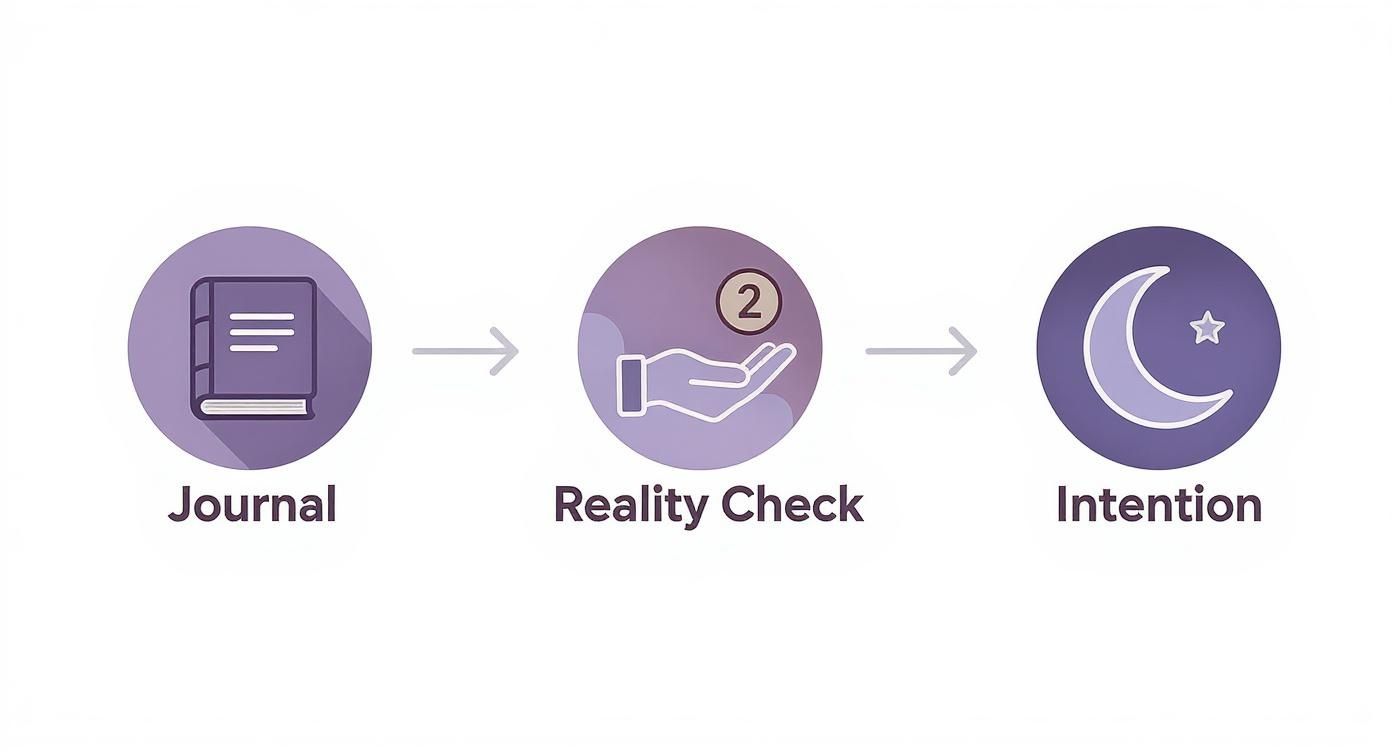
These three actions—journaling, reality checking, and setting an intention—create a powerful loop that helps train your brain for lucidity.
Quick Start Guide for Aspiring Dreamers
Here's a quick look at the first steps for starting your lucid dreaming journey.
| Action | Why It Helps | Practical Tip |
|---|---|---|
| Dream Journaling | Improves dream recall. The more dreams you remember, the more chances you have to become lucid. | Keep a notebook by your bed. Write down anything you remember the moment you wake up. |
| Reality Checks | Builds a habit of questioning reality. This habit can carry over into your dreams. | Ask yourself, "Am I dreaming?" 5-10 times a day. Try to push your finger through your palm. |
| Set an Intention | Primes your mind to recognize when you're dreaming as you fall asleep. | As you fall asleep, repeat the phrase: "Tonight, I will realize I am dreaming." |
These simple habits are the foundation for everything else. They're easy, effective, and anyone can do them.
The goal isn't just to have a lucid dream; it's to build a more mindful and curious relationship with your own mind, both awake and asleep. This process enhances creativity and self-awareness along the way.
This adventure is all about curiosity and practice. It strengthens imagination, builds self-confidence, and opens up a whole new world to explore. Let's get started on this exciting quest.
Creating the Perfect Dream Launchpad
Before you can learn to fly in your dreams, you have to build a solid launchpad. Think of your sleep routine exactly like that—a carefully prepared platform for your nightly adventures. Just like an astronaut goes through a detailed checklist before liftoff, a dreamer needs a healthy routine to clear the way for vivid, memorable dreams. This all boils down to good sleep hygiene.
It’s really just a fancy term for healthy sleep habits.
A rested mind is an aware mind. When your brain gets the deep, restorative sleep it craves, it has the spare capacity to suddenly realize, “Hey, I’m dreaming!” On the flip side, a chaotic bedtime routine makes dreams foggy and hard to grasp, but a calm, predictable one sets the stage for incredible experiences.
Why a Consistent Bedtime Is Your Superpower
If there’s one secret ingredient for successful dream exploration, it’s consistency. Going to bed and waking up around the same time every day—yes, even on weekends—is like setting your body’s internal clock. This simple act works wonders for regulating your sleep cycles, especially the REM (Rapid Eye Movement) stage.
That’s when all the magic happens. REM is where your most vivid dreams unfold.
When your brain knows exactly when to expect sleep, it moves through its nightly cycles far more efficiently. The result? Longer, more stable periods of REM sleep, which is prime time for becoming lucid. Someone who hits the sack at 11 PM every night is basically training their brain for success, creating a predictable rhythm that encourages rich, detailed dreams.
A stable sleep schedule isn't just a healthy habit; it's a direct line to more memorable dreams. You're training your brain to anticipate the dream state, which makes it that much easier to pop into full awareness.
Crafting a Screen-Free Wind-Down Hour
One of the biggest dream-killers in the modern world is the glowing screen. The blue light from phones, tablets, and TVs tricks our brains into thinking it’s still daytime, messing with the production of melatonin—the hormone that signals it's time to sleep. That’s why creating a screen-free wind-down hour before bed is a non-negotiable for anyone serious about lucid dreaming.
Instead of scrolling or watching videos, you can build a calming ritual that tells the brain it’s time to power down and prepare for dreamland. This turns the last hour of the day into a special, relaxing time.
Dream-Ready Wind-Down Activities:
- Reading a Book: Getting lost in a story, maybe one from The Dreams of Phillip Aisling series, is a fantastic way to light up the imagination without the harsh glare of a screen. It gently guides the mind from daily worries into the realm of adventure.
- Quiet Drawing or Journaling: This is a wonderfully meditative activity that allows for creative expression while calming the mind and turning attention inward.
- Listening to Calming Music or a Podcast: Gentle soundscapes or soothing stories can help an active mind settle down, making the transition to sleep smooth and easy.
Just imagine the difference. One person is watching an action-packed show right up until lights out, leaving their mind buzzing and agitated. Another spends that same hour curled up with a book, filling their head with wonder. Whose brain do you think is better primed for a night of incredible dreams?
This peaceful routine does more than just help you fall asleep. It actively prepares your mind for the journey ahead, turning good sleep hygiene into a fun and essential part of your lucid dreaming adventure.
Becoming a Dream Detective with a Journal
Every great detective needs a way to track clues, and for a dream explorer, that tool is a dream journal. Think of it as your own top-secret mission file for everything that happens after you fall asleep. Honestly, starting a journal is the single most important thing you can do on your lucid dreaming quest. After all, you can't become aware in a dream you don't even remember!

This simple habit sends a powerful message to your brain: "Hey, these dreams are important. Pay attention!" The more you jot down your dream adventures, the better your mind gets at holding onto those slippery morning memories, making them clearer and more detailed over time.
Your Dream Detective Toolkit
The best part? You don't need any fancy gadgets. A simple notebook and a pen stashed by your bed are the perfect tools for the job. The absolute best time to record your findings is the moment you wake up—before your feet even hit the floor or you start thinking about your day.
Dream memories fade incredibly fast, so capturing them right away is everything. Don't worry if you only remember a tiny piece, like the color of someone's shirt or a weird sound. Write it down. Those small clues often unlock a flood of other details.
What Clues to Look For
When you're writing, you're not just telling a story; you're on a hunt for patterns. Over time, these patterns become your personal map of the dream world, showing you the way to your first lucid dream.
Key Clues to Record in Your Journal:
- Feelings and Emotions: How did the dream make you feel? Happy, scared, confused? Emotions are powerful anchors for dream memories.
- Bizarre Events: Did anything impossible happen? Maybe you were breathing underwater, having a conversation with your dog, or floating through the office.
- Recurring People or Places: Do you keep dreaming about the same mysterious old house or a person you don't recognize from real life? Make a note every time they appear.
- Your Own Actions: What were you doing? Were you the hero, flying to the rescue, or were you just watching things unfold?
By consistently journaling, you're training your brain to be a better observer. This heightened awareness is the exact same skill you'll use to finally realize, "Hey, I'm dreaming!" right in the middle of a dream.
Finding Your Personal Dream Signs
After a few weeks of detective work, start flipping back through your journal. You're looking for repeating clues, which experienced lucid dreamers call "dream signs." A dream sign is anything—an object, person, place, or situation—that shows up in your dreams over and over again.
For example, you might look through your journal and notice something strange. In three different dreams over the past month, a mysterious purple cat has made an appearance. One time it was sitting on a fence, another time it was driving a tiny car, and last night it was ordering a pizza.
That purple cat is a fantastic dream sign!
Once you’ve identified a personal dream sign, you can use it to trigger a lucid dream. The next time you see that purple cat, your detective brain, sharpened by journaling, will sound the alarm: "Wait a second… purple cats don't drive cars. This has to be a dream!" That little moment of recognition is the spark that ignites a lucid dream.
Making Journaling Work For You
Journaling should never feel like homework. The real goal is to make it a creative and exciting part of your morning. If writing feels like a chore, there are tons of other ways to capture those dream memories.
Creative Journaling Ideas:
- Draw Your Dream: Instead of writing, grab some crayons or colored pencils and sketch a scene from your dream. This works especially well if you're a visual thinker.
- Give Your Dream a Title: If your dream was a movie, what would you call it? Titles like "The Day My Office Turned to Jell-O" or "Mystery of the Flying Dog" are fun ways to capture the main idea.
- Record the Silliest Part: You don't have to write down the whole dream. Just focus on the one weirdest or funniest thing that happened and describe that.
- Create a Dream Map: If you often dream of a specific place, like a magical forest or a strange city, try drawing a map of it. You can add new locations as you discover them in future dreams.
This detective work isn't just prep work; it's an adventure all on its own. You'll be amazed at the incredible, creative, and sometimes hilarious worlds your own mind builds every single night.
Playing Games with Reality Checks
Now that your dream detective work is underway, it's time for the real fun to begin. We're going to start playing games with our own minds using something called reality checks.
Think of them as secret tests you perform during the day. The goal is to build such a strong habit of questioning what’s real that you start doing it automatically in your dreams. That moment of questioning is often the spark that ignites a lucid dream.

It works because our waking world follows predictable rules. Walls are solid, text doesn't magically change, and we have ten fingers. The dream world? Not so much. Its rules are bendy and strange.
By testing these rules when you're awake, you create a powerful mental reflex. Sooner or later, when something bizarre happens in a dream, that reflex will kick in. You'll pause and think, "Hang on a minute… something's not right here!" And just like that, you're lucid.
Mastering Simple Reality Checks
The trick is to pick checks that are easy to remember and genuinely effective. You don't need any complicated techniques, just a healthy dose of curiosity. These simple tests are designed to give you one result when you're awake and a completely different—often surprising—one in a dream.
Here are a few of the most popular and effective reality checks:
- The Finger-Through-Palm Push: This one is a classic for a reason. Hold up one hand and try to gently push the index finger of your other hand through the center of your palm. While you're awake, your finger will stop. But in a dream, it’ll often pass right through like your hand is made of mist!
- The Re-Reading Test: Find a short piece of text—a sentence in a book, the time on a clock, or even a street sign. Read it, look away for a second, then look back and read it again. In the waking world, it will be the same. In a dream, the text will almost always have changed, scrambled into nonsense, or morphed into weird symbols.
- The Hand Check: This is the easiest one of all. Just look down at your hands. Do they look normal? Do you have the right number of fingers? In the wacky world of dreams, it's not uncommon to find you have six fingers, blurry palms, or fingers that stretch and wiggle like gummy worms.
Turning Reality Checks into a Habit
Consistency is what makes reality checks so powerful. You should aim to do one at least five to ten times a day. Instead of making it feel like a chore, try to build it into your routine.
A great way to do this is to set up "reality check triggers"—specific moments that remind you to do a quick check. For example: every time you walk through a doorway, look at your phone, or hear a bird sing, it's reality check time!
You could set hourly reminders on your watch or phone to prompt the question, "Am I dreaming right now?"
When you perform these checks, do it mindfully. Don't just go through the motions. Genuinely expect something strange to happen each time. This active curiosity is what primes your mind for that incredible "Aha!" moment inside a dream.
The Science Behind the Fun
This isn't just make-believe; this method is backed by solid research. The simple act of questioning your reality throughout the day has a real, measurable impact on your brain. Studies show that people who practice reality checks significantly increase their chances of having a lucid dream.
This consistent questioning builds a bridge of awareness between your waking and sleeping mind. You're basically teaching the logical part of your brain to stay a little bit "on" even when the rest of you is fast asleep. To dig into the fascinating science, you can read the full research about how these techniques influence lucidity.
The more you practice, the stronger this habit becomes, making it one of the most reliable and gentle ways to learn how to start lucid dreaming.
Gentle Ways to Wake Up Inside a Dream
You’ve already built the perfect launchpad for dream adventures, learned how to be a keen-eyed dream detective, and even started questioning reality. The next step is all about gently nudging your mind toward that magical “aha!” moment of awareness.
We’re not talking about complex or jarring methods here. Instead, these are simple, positive techniques designed to encourage your brain to wake up while you’re still sound asleep. Think of it like planting a seed: with a little care and intention before bed, you create the perfect conditions for a lucid dream to sprout.
Setting a Powerful Dream Intention
One of the kindest and most effective ways to spark a lucid dream is by setting a clear intention. This is a simple take on a proven technique called Mnemonic Induction of Lucid Dreams, or MILD. Don't let the fancy name fool you; it's really just about telling your mind what you want it to do.
As you’re lying in bed, feeling calm and cozy, you simply repeat a short, positive phrase. This acts as a gentle instruction for your sleeping brain.
Examples of Dream Intentions:
- "Tonight, when I'm dreaming, I will realize I'm dreaming."
- "I will notice when something strange happens in my dream."
- "The next time I dream, I will become aware."
The secret is to say it with meaning. Repeat your chosen phrase a few times, out loud or in your head, while truly focusing on what it would feel like to become aware inside a dream. You could even imagine yourself back in a recent dream from your journal and picture yourself suddenly realizing, "Wow, this is a dream!"
This simple act primes your mind for lucidity. It plants a suggestion that can blossom later in the night during your REM sleep, making it much more likely that the thought will pop into your head at just the right moment.
Setting a dream intention isn't magic; it's mental training. You're giving your subconscious a friendly reminder to stay alert for dream signs, making it an active partner in your quest for lucidity.
Using Natural Nighttime Awakenings
Another popular approach is known as Wake-Back-to-Bed (WBTB). The classic method involves setting an alarm, but we’re going to use a much gentler, more natural version that won’t disrupt a good night's sleep.
Many of us naturally wake up for a moment or two during the night, maybe to use the bathroom or just roll over. These brief awakenings are golden opportunities for lucid dreaming.
Instead of just drifting back to sleep, you can use this moment to reset your dream intention.
If you wake up, stay calm and quiet. Take a few deep breaths and gently repeat your intention: "When I go back to sleep, I will know I'm dreaming." This is incredibly powerful because the mind is still very close to the dream state, and the sleep that follows is often packed with vivid REM activity.
Weaving Intention into Your Bedtime Routine
To give these techniques a real boost, weave them directly into the calm, positive bedtime routine you’ve already established. Consistency is key here—it builds a strong mental link between preparing for sleep and preparing for lucid adventures.
Here’s how you can combine these gentle methods for the best results:
- Review Your Journal: Spend a few minutes before bed flipping through your dream journal. Remind yourself of recent strange dreams and potential dream signs. This gets the mind focused on the dream world.
- Set Your Intention: As a final step before lights out, repeat your dream intention phrase until you feel yourself drifting off. Make it a calming, positive ritual.
- Plan for Night Awakenings: Gently remind yourself that if you happen to wake up, it's a special chance to whisper your dream intention to yourself before drifting back off.
This consistent, patient practice teaches the brain to hold onto that little spark of awareness as it transitions into sleep. It's a playful and peaceful way to start exploring the amazing worlds that await every single night.
A Beginner's Guide to Navigating Dream Worlds
As you start exploring lucid dreaming, you're bound to have questions. That’s perfectly normal. Supporting your journey is all about keeping the lines of communication open and turning any little bumps in the road into moments for learning. Think of yourself as a guide, helping yourself navigate your inner world with curiosity and confidence.
One of the most incredible benefits of lucid dreaming is how it can completely reframe scary dreams. Nightmares feel so real and out of control, which is what makes them terrifying. But the instant you realize you're dreaming, you gain a massive advantage: the knowledge that it isn't real.
Turning Nightmares into Adventures
That simple realization changes everything. When you know you're in a dream, that scary monster isn't a monster anymore—it’s just a thought. You can use a few creative strategies to take back control of the dream.
- Change the Scenery: Is the dream setting a little spooky? Imagine a door that opens to your favorite place, whether it's a sunny beach or a peaceful forest.
- Give Yourself a Superpower: If you're being chased, you can suddenly decide to fly, become invisible, or even grow to the size of a giant.
- Talk to the Scary Thing: This one is surprisingly effective. Try calmly asking the scary figure what it wants. You'd be amazed how often the answer completely dissolves the fear.
Thinking about these ideas during the day helps build a mental toolkit you can pull from when a dream takes a strange turn. Framing it as learning "dream magic" can make the whole process feel empowering instead of stressful.
By equipping yourself with these simple tools, you're not just helping yourself overcome a bad dream. You're learning resilience, problem-solving, and the powerful idea that you have agency even when facing your fears.
Troubleshooting Common Dream Hurdles
It's common for new dreamers to hit a few snags. Calm guidance can make all the difference. A frequent issue is getting so excited about becoming lucid that you wake yourself up. If this happens, try to stay calm in the dream, perhaps by focusing on your hands or spinning around to help stabilize the scene.
Another thing you'll see is spotty dream recall. Some weeks you might remember a handful of dreams every night, and other weeks, nothing. This is completely normal. Big changes in your routine or life events can definitely shake up dream patterns. A 2022 study actually found that the likelihood of frequent lucid dreaming shot up by over 35% during the COVID-19 pandemic, which shows just how much our outside world can affect our inner one. You can read more about how life events influence lucid dreaming in the study.
Be patient and stick with your dream journal, and trust that your dream memories will come back. Your own support is the most important part of this whole adventure, making sure your exploration of lucid dreaming stays positive and fun.
Got Questions? Let's Talk Lucid Dreaming
It's natural to have a few questions before diving into the world of lucid dreaming. Let's tackle some of the most common ones.
Is Lucid Dreaming Safe?
Absolutely. Lucid dreaming is a natural state of consciousness and is perfectly safe. Think of it less as some strange new activity and more as a way to engage with your own mind.
When you approach it with curiosity and fun, lucid dreaming can be an incredible tool for building creativity, boosting problem-solving skills, and fostering confidence. The key is to create a supportive, open mindset where you feel excited—not pressured—to explore your dream adventures.
What if I Have a Scary Lucid Dream?
This is where lucid dreaming truly shines. The moment you become lucid, you have the upper hand because you know it’s just a dream. This awareness is incredibly empowering.
You can equip yourself with a toolkit of "dream superpowers." If a scary monster appears, you can try flying away, changing the scene like flipping a TV channel, or even bravely asking the scary figure what it wants. Often, this simple act of engagement can transform a frightening moment into a powerful lesson in courage and self-discovery.
How Long Does It Take to Have a Lucid Dream?
There's no magic timeline, and that's okay! It’s different for everyone. Some people might stumble into a lucid dream within the first week of trying, while others might take a month or more of practice.
The best advice? Be patient and celebrate the small wins, like remembering a new dream detail or successfully doing a reality check during the day. Focus on the fun of the journey, not just the destination.
Ready for more dream adventures? The Dreams of Phillip Aisling Series brings the magic of lucid dreaming to life through thrilling stories that inspire courage and imagination. Start your journey today.