
If you want to get better at remembering your dreams, the most powerful moments are the ones right before you fall asleep and right after you wake up. It’s that simple. Setting a clear intention to remember before bed and then lying perfectly still when you wake up to "fish" for dream fragments are the two most effective places to start.
The Science of Why We Forget Our Dreams

Have you ever woken up with the ghost of an incredible dream? That feeling or image that was so vivid, so real, it felt like a memory… only to watch it dissolve like mist in the morning sun. It happens to all of us.
It’s not a personal failing or a sign you don’t dream. The truth is, you almost certainly dream every single night. Forgetting them is just a normal part of how our brains work during sleep.
Understanding this process is the first step toward remembering your dreams better. It’s less about brute force and more about working with your brain's natural rhythms.
Why Memories Fade by Morning
The main reason dreams are so slippery comes down to the architecture of our sleep cycle. While we can dream at any time, the most detailed, story-rich dreams happen during Rapid Eye Movement (REM) sleep. In this stage, your brain is buzzing with activity, looking a lot like it does when you're wide awake.
But the chemistry is completely different. During REM sleep, the levels of norepinephrine—a key chemical for locking in solid, long-term memories—take a nosedive. This is likely by design, possibly to keep our brains from mixing up bizarre dream adventures with actual real-life memories.
This creates a fascinating paradox:
- Your brain is active enough to create entire worlds and intricate stories.
- But the chemical environment isn't set up to actually store those experiences.
So, when you wake up, that dream memory is incredibly fragile. It’s sitting in your short-term storage, ready to vanish at the slightest distraction—your alarm, a full bladder, or the first thought about your to-do list.
Your Brain Is Wired for Recall
Here's the good news: dream recall is a skill you can train. It's directly linked to what's happening in your brain when you wake up.
Lab studies show that around 80% of people woken up directly from REM sleep can recall their dreams in great detail. Research also shows a link between frequent dream recall and higher activity in the medial prefrontal cortex (MPFC), a part of the brain tied to self-reflection and memory. You can read more about these brain findings and their connection to dream recall.
The ability to remember dreams isn't a gift; it's a bridge between your waking and sleeping mind that you can consciously strengthen. Every time you focus on recalling a dream, you reinforce the neural pathways that make the next one easier to catch.
Think of it like building a muscle. At first, it feels tough, and you might only grab tiny fragments. But with consistent, gentle effort, you start building the mental "muscle" needed to pull entire dream stories from the depths of your mind into the light of day.
Priming Your Mind for Dream Recall Before Sleep
Forgetting your dreams is frustrating, but here’s the secret: remembering them doesn’t start when your alarm goes off. It starts the night before.
By creating a simple pre-sleep routine, you’re basically sending a memo to your brain that says, “Hey, pay attention to this stuff tonight. It’s important.” This small shift primes your mind to hold onto those fleeting nighttime adventures long enough to write them down.
Set a Clear Intention
This is one of the easiest and most powerful things you can do. Right before you drift off, just say to yourself—out loud or in your head—“Tonight, I will remember my dreams when I wake up.”
That's it. This simple act is a potent psychological cue. It tells your subconscious what to prioritize, making it much more likely that your dream experiences will make the leap from sleeping memory to waking awareness. Think of it like highlighting a passage in a book you know you'll need to find later.
Setting an intention is a way of telling your mind, "This is important. Pay attention." This simple command can dramatically shift your focus and improve your recall almost overnight, a technique that characters like Phillip Aisling might use to become more aware in their dream worlds.
Create a Dream-Ready Environment
Your bedroom setup plays a huge role in your sleep quality and, by extension, your ability to recall dreams. A room full of distractions leads to choppy sleep, which keeps you from hitting those long, deep REM stages where the most vivid dreams happen.
- Cool and Dark: A cool, dark, and quiet room is non-negotiable for good sleep. Nudge the thermostat down a degree or two and use blackout curtains or an eye mask to kill the light.
- Silence the Noise: If you've got noisy neighbors or live on a busy street, a white noise machine or a good pair of earplugs can create a calming, consistent soundscape that won’t jar you awake.
- Comfort is Key: Your bed should be a sanctuary for sleep. When you reserve it just for resting—not working or scrolling—your brain builds a powerful association that helps you power down faster.
Implement a Digital Sundown
You’ve probably heard this before, but it’s crucial. The blue light blasting from our phones, tablets, and computers messes with melatonin, the hormone that tells your body it's time to sleep.
About an hour before bed, declare a "digital sundown." Put your devices away and do something relaxing and screen-free. You could read a book (maybe something from The Dreams of Phillip Aisling Series to get your mind into a creative state), do some light stretching, or listen to calm music. This helps clear out the day's mental clutter, leaving a clean slate for your dreams.
Your Pre-Sleep Dream Recall Checklist
To make this even easier, here’s a quick checklist you can run through each evening. It pulls together the key steps for creating the perfect pre-sleep ritual to boost dream recall.
| Action | Why It Works | Simple How-To |
|---|---|---|
| Digital Sundown | Reduces blue light exposure, which can disrupt melatonin production. | Put all screens away 60 minutes before bed. Pick up a book instead. |
| Create a Calm Space | Minimizes disruptions that can pull you out of deep REM sleep. | Dim the lights, lower the thermostat, and turn on a fan or white noise machine. |
| Relax Your Mind | Quiets the mental "noise" from the day, making it easier to drift off. | Try light stretching, meditation, or listening to ambient music for 10-15 minutes. |
| Set Your Intention | Primes your subconscious to prioritize and remember dream content. | As you're lying down, repeat to yourself: "I will remember my dreams." |
Following this checklist doesn't have to be rigid. Just find a few things that work for you and stick with them. Consistency is what really trains your brain to start paying attention.
Practice Daytime Awareness Checks
This one might sound a little strange, but it’s a game-changer for those interested in lucid dreaming. A few times during the day, pause and genuinely ask yourself, "Am I dreaming right now?" Then, look for evidence.
This is called a reality check. For example, look closely at your hands. Now look away and look back. In a dream, your hands might look blurry or have the wrong number of fingers. Another classic check is to try pushing your finger through the palm of your other hand. If it goes through, you’re definitely dreaming!
This habit builds critical awareness that can bleed over into your sleep. When you get so used to questioning reality, you might just do it in a dream—and boom, you’ve become lucid. Once you're aware you're dreaming, the entire experience becomes instantly more vivid and far easier to remember.
The Critical First 5 Minutes After Waking Up
How you wake up makes all the difference. Those first few moments are a fragile, foggy window where your nighttime adventures can either lock into memory or dissolve into thin air. If there's one golden rule, it's this: stay still.
Fight that powerful, almost magnetic pull to roll over, stretch, or grab your phone. The second your body moves or your brain snaps to attention with its daily to-do list, the delicate threads of a dream memory are gone. Poof.
Gently Fishing for Dream Fragments
Think of your dream like a shy fish hiding just beneath the surface of your awareness. Make one sudden move, and it's gone, darting back into the deep. The secret is to be quiet and patient.
Stay in the exact position you woke up in. Let your eyes stay closed, or if they're open, just let them rest softly on a neutral spot. Let your mind drift without trying to force anything. Don't ask, "What was I dreaming about?" It's too aggressive.
Instead, try asking gentler, softer questions:
- How am I feeling right now? (Happy, anxious, confused?)
- Are there any colors hanging around in my mind's eye?
- Is there a snippet of a sound or even a single word floating by?
Often, a single emotion or a bizarre image is the thread you can gently pull. For instance, you might wake up with a lingering feeling of being rushed. If you focus on that feeling—not analyzing it, just holding it—you might suddenly remember you were in a dream, running through a strange train station. That's how you reel the memory in.
This process chart shows the simple flow from setting your intention at night to being mindful as you wake, which is the key to capturing these fleeting moments.
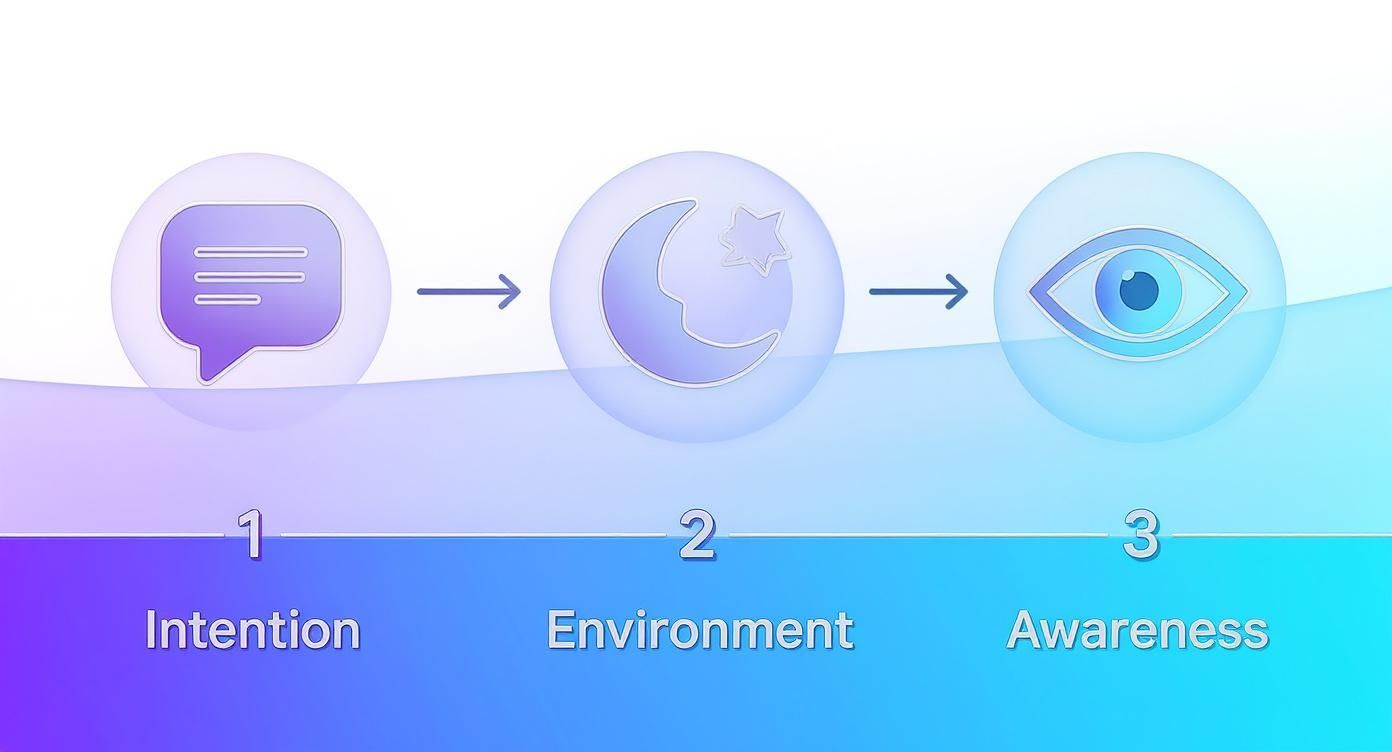
As the graphic shows, the prep work you do before sleep directly pays off when it's time to capture dreams, creating a complete cycle of recall.
A Gentle Wake-Back-to-Bed Technique
For those who want to level up their recall, there’s a modified version of the Wake-Back-to-Bed (WBTB) technique, a favorite among lucid dreamers. The whole idea is to wake up directly from a REM sleep cycle when your dreams are at their most vivid.
Don't worry, this doesn't mean a jarring, blaring alarm. Quite the opposite. Set a very soft, gentle alarm—think chimes or nature sounds—to go off about 90 minutes before you normally wake up.
When that gentle sound nudges you awake, simply turn it off and lie perfectly still. You've just landed in prime dream-catching territory. Use the "fishing" technique to see what dream fragments are right there at the surface. After a few minutes of quiet reflection, you can drift back to sleep or get up and immediately jot down what you found in your dream journal.
Waking up gently during a late-stage REM cycle is like intercepting a message right as it's being delivered. The dream is fresh, vivid, and hasn't had time to be overwritten by the logic of your waking brain. This technique significantly increases the odds of detailed recall.
How to Keep a Dream Journal That Actually Works

If you're serious about remembering your dreams, a dream journal is your single most powerful tool. Think of it less like a diary and more like a training ground for your memory. The simple act of writing (or even speaking) your dreams sends a clear signal to your brain: "Hey, this is important. Let's hang onto it."
When you're just starting out, consistency is everything. Don't worry about writing down every last detail. Even jotting down "don't remember anything" is far better than skipping a day. This keeps the habit alive and reinforces the message that you're ready and waiting to listen.
Find a Journaling Method You Will Actually Use
The best dream journal isn't the fanciest one—it's the one you'll actually reach for at 3 AM. The goal is to make capturing those fleeting dream fragments as easy as possible. Forget the perfect system and focus on what’s practical.
Here are a few popular options:
- Classic Pen and Paper: There's a reason this is the go-to method. A simple notebook and pen on your nightstand just works. Pro tip: keep a small book light nearby so you don't have to blast a bright lamp and fully wake yourself up.
- Voice Memos: If fumbling for a pen in the dark sounds like a chore, your phone's voice recorder is a brilliant alternative. Just press record and whisper whatever you remember. You can always write it out later if you want a physical copy.
- Dedicated Journaling App: Some apps are built specifically for dream journaling, with built-in prompts and tagging features. Just be careful with that bright screen—crank the brightness all the way down before you open the app.
Whatever you choose, have it ready before you go to sleep. The last thing you want is to hunt for your journal while that fragile dream memory evaporates into thin air.
Go Beyond the Plot with Specific Prompts
A good dream journal entry captures what happened. A great one captures what it was like. The real magic is in the details—the feelings, the strange sensations, and the symbols that give a dream its unique flavor. This is what truly anchors the memory.
So instead of just writing, "I was flying," train yourself to dig a little deeper.
The most powerful shift you can make in your dream journaling is moving from "What happened?" to "What was it like?" This simple change in perspective unlocks a richer layer of detail and emotion, making the memory far more resilient.
Try using these prompts the moment you wake up to guide your writing:
- Emotions: What was the main feeling? Were you thrilled, terrified, confused, or full of joy?
- Sensory Details: What did you see, hear, or feel? Was the wind cold? Did the ground feel soft? Was there a specific sound or a lingering smell?
- Key Symbols: Did any objects, people, or places jump out? A mysterious key, a recurring animal, or an old childhood friend could all be significant.
- Your Role: Were you driving the action, or were you just a passive observer watching it all unfold?
Focusing on these elements makes the memory "stickier." Interestingly, science backs this up. The emotional charge of a dream can directly impact how well you remember it. Recent studies show that intense emotions, especially anxiety, are linked to better retention of visual memories after sleep. Your brain naturally prioritizes recalling emotionally charged dreams, a process that also helps dial down your emotional response to those memories the next day. You can read more about this in this fascinating research on dream affect.
Using Dream Recall to Enhance Learning and Creativity
Remembering your dreams is so much more than a quirky hobby. Think of it as opening a direct line to your brain’s creative powerhouse—the part that works on problems and cements new memories while you sleep.
Dreams aren't just random noise. They're often a reflection of your waking life, where your mind chews on challenges and connects ideas without the rigid rules of logic getting in the way. Tapping into that process can unlock some genuinely useful insights.
Your Brain's Overnight Problem-Solving Crew
While you're asleep, your brain is busy making connections that your conscious mind might have completely missed during the day. It sifts through memories, links unrelated concepts, and runs simulations on whatever you've been wrestling with.
Ever heard of a musician waking up with a new melody fully formed in their head? Or a coder who suddenly dreams up the fix for a stubborn bug? Those aren't just lucky flukes. They're the output of your brain’s incredible overnight processing. Learning to recall your dreams simply gives you access to that hidden work.
A dream journal isn't just a log of strange stories; it's a map of your mind in action. When you review it, you start to see patterns and solutions that were invisible in the light of day.
How Dreams Help You Learn and Master New Skills
Dreaming is also absolutely vital for making new knowledge stick. Your brain doesn't just switch off at night. Instead, it replays and rehearses the things you learned, which is a core part of how we build skills and form lasting memories.
Researchers have found solid links between dream content and memory consolidation. People who dream about material they've recently studied consistently perform better on tests the next day. One fantastic study even found that students in a French immersion program who started dreaming in French showed the biggest gains in language skills. You can read more about the link between dreaming and language learning in the study itself.
So, how can you put this to work for you? It's simpler than you might think.
- Do a Weekly Review: Carve out a little time each week to read through your latest dream entries.
- Hunt for Connections: Ask yourself, "What was really on my mind this week?" or "How might that bizarre dream about flying squid relate to the project I was stuck on at work?"
- Act on What You Find: Did you dream of climbing a tough mountain the same week you were fighting with a difficult assignment? Maybe your mind was offering you a metaphor for perseverance.
When you start actively engaging with what your dreams are telling you, they stop being fleeting, forgotten experiences. They become a powerful, practical tool for creativity and personal growth.
Troubleshooting Common Dream Recall Problems
As you start this adventure into the world of dreams, a few questions are bound to pop up. Hitting a snag here and there is a completely normal part of the process. Think of it like learning any new skill—there's always a learning curve!
Let's walk through some of the most common hurdles people face when trying to get better at remembering their dreams.
Why Do I Only Remember Nightmares?
It's a strange feeling, isn't it? Waking up with your heart pounding, the details of a scary dream crystal clear, while pleasant dreams seem to evaporate like morning mist. There's a good reason for this.
Intense emotions, especially fear, fire up the brain's threat-detection and memory centers. Your brain is hardwired for survival, so it flags these experiences as crucial information. "Hey, pay attention to this! It might be important!"
To start catching those gentler, more positive dreams, you have to send a new message to your brain: all dreams are worth remembering. By making a consistent effort to recall and jot down anything you can each morning, you're training your mind to tune into the quieter dream stories, not just the loud, scary ones.
The Dream Vanishes the Moment I Try to Write It Down
This is easily the most common frustration, and it can feel maddening. Dream memories are incredibly delicate. The simple act of trying to form a coherent sentence—switching from dream-logic to waking-logic—can be enough to make the whole thing shatter.
The trick is to use what I call "dream tethers" before the memory floats away.
The second you wake up, before you even think about writing a full story, stay as still as possible and grab your journal. Scribble down single words, fragments, feelings, or images. No sentences allowed yet!
Blue doorFeeling of being lateSound of rain on pavementSmell of old books
These little notes act as anchors. They tether the dream to your conscious mind. Once you have a few of these down on the page, the pressure is off. You can then use them as prompts to gently build the full narrative around them, without the fear of it all slipping through your fingers.
Is It Possible I Just Don't Dream?
Nope! It’s scientifically established that pretty much everyone dreams, several times a night, especially during REM sleep. That feeling of not dreaming is almost always a dream recall issue, not an absence of dreams.
Your dream world is there, every single night. The challenge is strengthening the bridge between your dreaming mind and your waking mind. Each time you set an intention, lie still upon waking, and reach for your journal, you're laying another plank on that bridge.
How Long Will This Take to Work?
There's no one-size-fits-all answer here. Some people see a huge jump in their dream recall after just a few nights of consistent practice. For others, it might be a few weeks before they start noticing a real difference.
The secret ingredient is consistency, not perfection.
Don't let a "dry" night get you down. If you wake up with nothing, that's okay! Just making the effort to remember is what strengthens those neural pathways. Celebrate the tiny victories—recalling a single color, a fleeting emotion, or a strange sound. Those small wins are the building blocks for full, vivid dream recall.
Continue your journey into the world of dreams with The Dreams of Phillip Aisling Series, where young adventurers learn the art of lucid dreaming in a captivating fantasy world. Explore the series at phillipaisling.com and discover where your dreams can lead.