
Want to learn how to lucid dream tonight? Let's get straight to the most effective approach. The quickest way is to combine a few proven techniques: set a clear intention before bed, consistently question your reality during the day, and then—the real game-changer—strategically wake yourself up during a peak dream cycle to slide back into your dream with full awareness.
While it's not a guaranteed success on the first try, this focused strategy gives you a much better chance than just hoping it will happen.
Your Action Plan for Lucid Dreaming Tonight
Becoming aware that you’re dreaming is a skill that blends simple daytime habits with powerful nighttime intentions. The good news is you don’t need any special gadgets or years of practice. Success often comes down to a simple, repeatable plan that primes your mind for that incredible "aha!" moment of lucidity.
Think of it as giving your brain a clear set of instructions to follow once you fall asleep. The goal is to make the act of questioning reality so automatic that it spills over into your dream world.
This isn't some rare ability; it's a documented human experience. Studies show that about 55% of adults have experienced a lucid dream at least once, and a solid 23% have them monthly. This confirms the potential is already within most of us; a focused strategy simply helps unlock it. If you're curious, you can explore the full findings on lucid dream frequency in this fascinating study.
Priming Your Mind for Awareness
The journey to a lucid dream tonight actually begins this morning. Your waking mind needs to get into the habit of checking in with itself. By building this mental muscle, you significantly increase the chance of one of those "check-ins" happening while you're deep in a dream—and that's the trigger that flips the switch to lucidity.
This chart illustrates how your efforts during the day, right before bed, and in the middle of the night all connect.
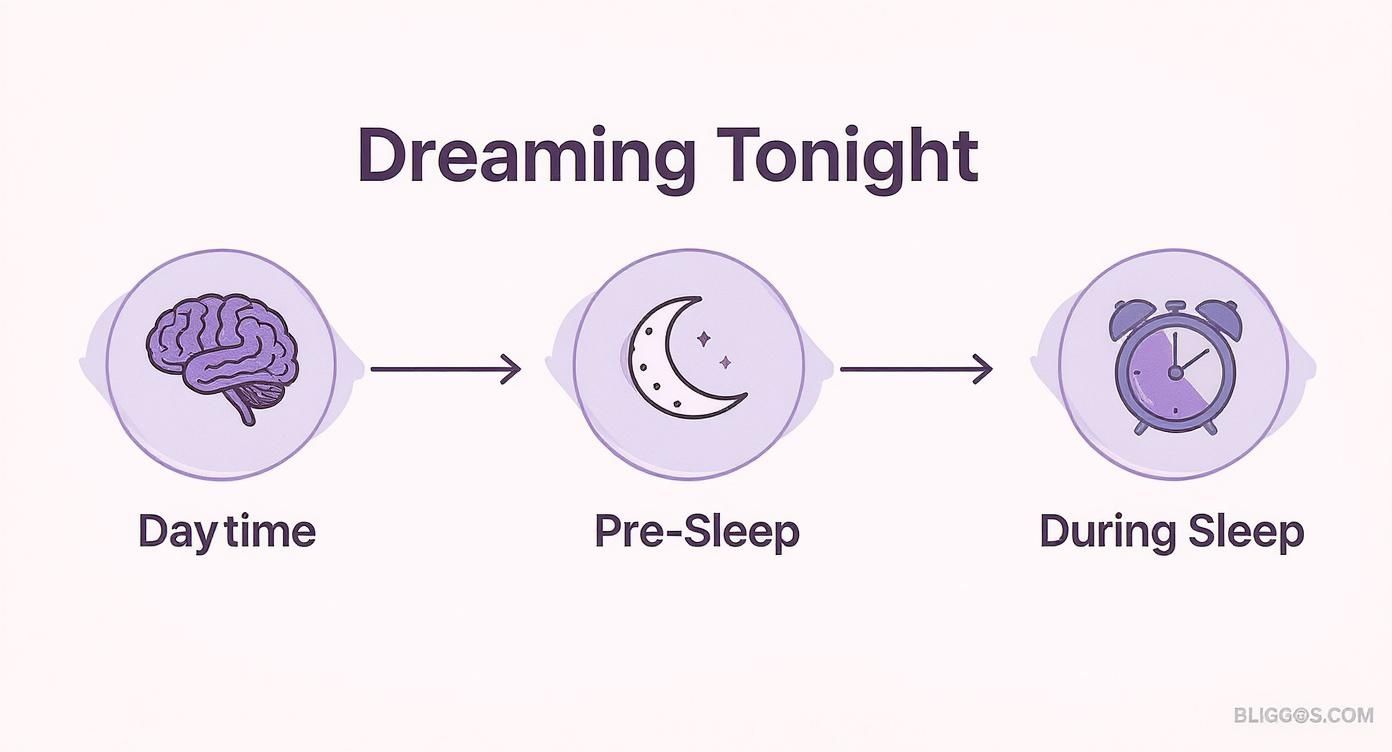
As you can see, success tonight isn't about a single magic trick. It's about a sequence of simple actions that build upon each other.
To help you stay on track, here's a quick action plan that boils everything down to the essentials.
Lucid Dreaming Tonight Action Plan
This table is your cheat sheet. It breaks down the core techniques—what they are, when to do them, and the single most important action for each one. Keep this in mind as you go through your day and get ready for bed.
| Technique | When to Do It | Key Action |
|---|---|---|
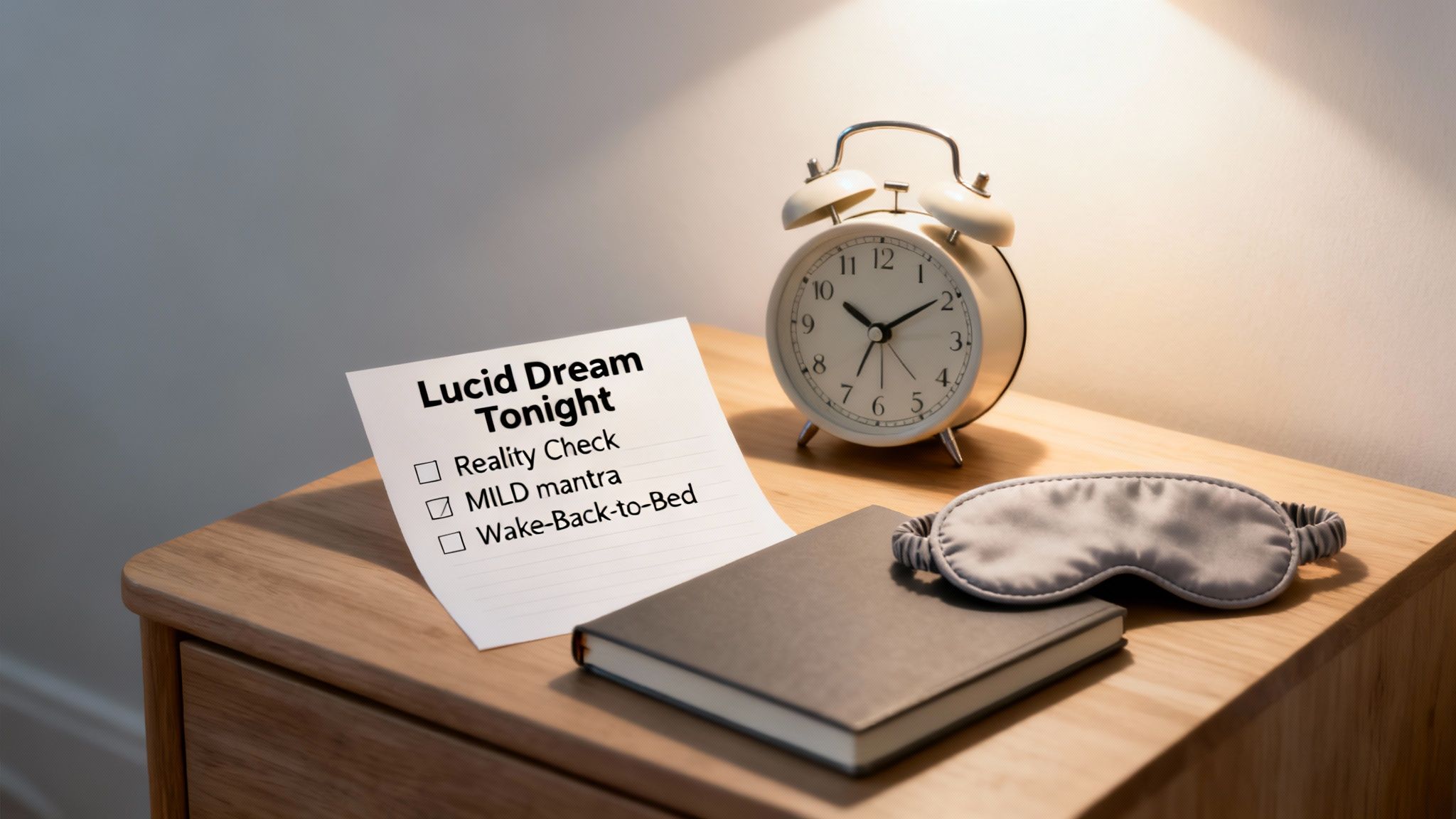
| Reality Testing | Throughout the day (5-10 times) | Ask, "Am I dreaming?" and perform a physical check. |
| Mnemonic Induction (MILD) | As you're falling asleep | Repeat the mantra: "Next time I'm dreaming, I will remember." |
| Wake-Back-to-Bed (WBTB) | 4-6 hours after falling asleep | Wake up briefly, focus on your intention, then go back to sleep. |
By focusing on these three steps, you're setting the stage for your mind to recognize a dream from within.
The Core Techniques at a Glance
Three foundational methods are the bread and butter of most successful lucid dreaming attempts: Reality Testing, Mnemonic Induction of Lucid Dreams (MILD), and Wake-Back-to-Bed (WBTB). Each one plays a unique and crucial role in building your awareness.
- Reality Testing: This is your daytime practice. You'll perform small, frequent checks to genuinely question whether you’re awake or dreaming.
- Mnemonic Induction (MILD): This is your pre-sleep ritual. You'll use visualization and repetition to program your brain to recognize a dream state.
- Wake-Back-to-Bed (WBTB): This is a powerful amplifier. It involves waking up for a short period during a peak dream stage (REM sleep) to re-enter your next dream with your awareness heightened.
Pro Tip: Combine these methods, especially WBTB with MILD, for a powerful synergistic effect. The WBTB technique gets you neurologically primed for a vivid dream state, and MILD provides the mental trigger you need to recognize it once you're there.
Build a Habit of Questioning Reality
The secret to lucid dreaming tonight doesn’t start when your head hits the pillow. It starts right now. To become aware inside a dream, you first have to build the habit of asking, "Am I dreaming?" while you are awake.
This practice is called reality testing, and it's more than just asking a question; it's about genuinely investigating your environment. Your dreaming mind is brilliant and creative, but it's often lazy with small details. When you train yourself to spot these inconsistencies while awake, you're setting a powerful tripwire that can catch you in a dream.
Integrate Reality Checks into Your Day
To make this habit stick, link your reality checks to existing daily actions. Every time you walk through a doorway, check your phone, or look in a mirror—pause. This turns a normal action into a trigger for lucidity.
Here are a few highly effective reality checks that exploit common dream world glitches:
- The Finger-Palm Push: Try to push the index finger of one hand straight through the palm of your other hand. In the real world, it stops. In a dream, it will often pass right through. That's a clear giveaway.
- The Text Reread: Glance at a line of text on your phone or in a book. Read it, look away, then look back. In a dream, the words will almost always have changed, scrambled, or turned to nonsense.
- The Clock Check: This works just like the text check but with a digital clock. Look at the time, look away, and look back. Dream clocks are notoriously unreliable; the numbers might be impossible or change dramatically.
The trick is to perform these checks with genuine curiosity. Don’t just go through the motions. Truly expect your finger to pass through your hand or for the text to morph. It's this mindful intention that reprograms your brain to perform the same check while you're asleep.
By performing reality checks consistently, you're programming your subconscious mind. You’re teaching it to recognize the bizarre logic of dreams, making that moment of lucid awareness far more likely.
Set a Powerful Waking Intention
Alongside reality checks, set a firm intention. This isn't just a wish—it's an active, conscious decision you repeat all day long. Think of it as a direct message to your future dreaming self.
Keep your intention clear and simple. Repeat this phrase to yourself multiple times throughout the day: "Tonight, when I am dreaming, I will realize I am dreaming." Say it with conviction when you wake up, every time you do a reality check, and especially as you're getting ready for bed.
This mental priming acts as a homing beacon for your sleeping mind, communicating your goal directly to your subconscious. This process is a key part of the Mnemonic Induction of Lucid Dreams (MILD) technique, and it’s foundational for getting results fast.
In the world of The Dreams of Phillip Aisling, the characters use similar methods to hone their dream skills. They learn that their daytime focus directly shapes their nighttime adventures—a lesson you can apply to your own journey. This combination of habit and intention is your most powerful tool.
Craft Your Own Pre-Sleep Lucidity Ritual
The hour before you sleep is your golden opportunity to steer your dreams. This isn't just about winding down; it's your strategic launchpad for becoming lucid. A consistent pre-sleep ritual signals to your brain, "Tonight, we're waking up in the dream."
First, turn your bedroom into a sleep sanctuary. The goal is to reduce all external stimuli—both literal and mental—that can disrupt the deep sleep stages where dreams come alive. This means making your room as dark and quiet as possible.
Even more critical is ditching the blue light from screens. The glow from your phone, tablet, or TV interferes with your body's melatonin production and can disrupt your REM sleep cycles—the very cycles where your most vivid dreams happen. Make it a hard rule: all screens off at least 30-60 minutes before your head hits the pillow.
Settle Into a Calm, Focused Mindset
With your environment optimized, the next step is to find a simple, calming activity. This isn't about trying hard to have a lucid dream, which can create counterproductive anxiety. It's about gently guiding your mind toward a state of relaxed awareness.
Choose something that quiets the day's chatter without overstimulating your brain. Light reading (a physical book is best), listening to soft ambient music, or doing a few minutes of mindfulness meditation are all excellent choices. The goal is to shift from the hustle of the day to a peaceful, receptive mental state.
This quiet time is the perfect moment to reinforce the intention you set earlier. As you relax, softly repeat your phrase to yourself, such as, "Tonight, I will realize I am dreaming." This simple repetition plants a seed in your subconscious, making it far more likely to sprout once you're asleep.
Anchor Your Intention to a Sensation
To enhance this process, introduce a dream anchor. This is a specific sensory cue—a scent, a touch, a sound—that you deliberately link to your goal of becoming lucid. It acts as a bridge connecting your waking intention to your sleeping mind.
Here are a few simple dream anchors you can try tonight:
- A Unique Scent: Put a tiny dab of a calming essential oil like lavender on your wrist or pillowcase. As you drift off, focus on that smell and your intention.
- A Physical Object: Hold a small, smooth stone or another meaningful object in your hand. Concentrate on its texture and weight as you fall asleep.
- A Gentle Sound: Play a very quiet, continuous sound in the background, like a soft hum or an ambient track. Let this be the last thing your mind tunes into.
When you consistently pair a sensory cue with your lucid dreaming goal, you forge a powerful mental connection. If that scent, feeling, or sound appears in your dream, it can be the very trigger that makes you realize you're dreaming.
Proven Techniques to Kickstart a Lucid Dream
With your mind and bedroom ready, it’s time for the specific, hands-on methods that can help you learn how to lucid dream tonight. These are practical exercises designed to bridge the gap between your waking intention and your sleeping awareness.
Our goal is to trigger a Dream-Initiated Lucid Dream (DILD), which is when you become aware you're dreaming from inside the dream itself. This is much more approachable for beginners than the advanced Wake-Initiated Lucid Dream (WILD), where you try to maintain consciousness as your body falls asleep. We're focusing on DILDs to give you the best shot tonight.

Master Mnemonic Induction of Lucid Dreams (MILD)
The Mnemonic Induction of Lucid Dreams (MILD) technique is about programming your subconscious. It works by using your prospective memory—the same mental function you use to remember to pick up milk on the way home. Here, you're training your brain to remember to notice when you're dreaming.
As you lie in bed, ready to drift off, recall a recent dream. If you can’t remember one, just invent a dream scenario. Now, replay that dream vividly in your mind.
Here’s the crucial part: at some point in your mental movie, imagine yourself suddenly recognizing it’s a dream. See yourself stopping, looking down at your hands, and declaring, "I'm dreaming!" Feel the jolt of excitement that comes with that realization.
While you visualize this, repeat a simple mantra with real intention. The classic one works great:
"The next time I'm dreaming, I will remember that I'm dreaming."
Don't just mouth the words. Set a firm, clear command for your sleeping mind to follow. Let this be the very last thing you think about as you fall asleep.
Leverage the Wake-Back-to-Bed (WBTB) Method
The Wake-Back-to-Bed (WBTB) method is a game-changer because it targets your brain when it's most primed for dreaming. The idea is to briefly wake up during a later REM cycle—when dreams are longer and more vivid—and then slide back into sleep with your lucid intention fresh in your mind.
Here’s how to do it:
- Set an alarm for about 4 to 6 hours after you normally fall asleep. This is prime time for a rich REM period.
- Get out of bed when the alarm goes off. You only need to stay awake for about 20 to 30 minutes.
- Focus your mind on something dream-related. Read a few pages about lucid dreaming, review your dream journal, or simply sit quietly and think about your goal. Just be sure to avoid bright screens like your phone.
The Power of Combining WBTB with MILD
This is where the real magic happens. After your brief WBTB wake-up, get back into bed and immediately practice the MILD technique. Your mind is in a perfect state: alert enough to set a strong intention but sleepy enough to return to dreamland quickly.
For beginners, this one-two punch is one of the most effective strategies out there. WBTB gets your brain ready for vivid REM sleep, and MILD gives you the mental trigger to become lucid once you're in it.
To help you decide which technique (or combination) is right for you, here’s a quick comparison.
Comparing Popular Lucid Dream Induction Techniques
| Technique | Best For | How It Works | Difficulty Level |
|---|---|---|---|
| MILD | Beginners who want a simple, low-effort technique before sleep. | Uses intention-setting and visualization to program your mind to recognize when you're in a dream. | Easy |
| WBTB | People who can wake up and fall back asleep without much trouble. | Interrupts sleep during a key REM cycle to increase alertness and dream recall upon returning to sleep. | Medium |
| Combo | Anyone serious about having a lucid dream tonight. | WBTB primes the brain for vivid dreams, while MILD provides the direct mental trigger to become lucid within them. | Medium |
As you can see, combining the methods gives you the best of both worlds.
Research consistently shows that layering techniques produces the best results. One study, for example, found that when participants combined MILD with other factors, their success rate for lucid dreaming jumped to 42% of nights. That’s a huge leap from the 14% success rate of a placebo group using the same methods. This demonstrates how a multi-layered approach can stack the odds in your favor.
If you're curious, you can explore more about how combined methods significantly increase lucidity. By using these proven techniques together, you’re creating the perfect storm for becoming aware in your dreams tonight.
What to Do When You Wake Up
Your lucid dreaming work doesn’t stop when your alarm goes off. In fact, what you do the moment you wake up is crucial. To learn how to lucid dream tonight, you must first remember what you dreamt last night.
The single most powerful habit for any aspiring lucid dreamer is keeping a dream journal. This cannot be overstated. Recording your dreams creates a powerful feedback loop: the more you focus on them, the more you remember. The more you remember, the better you become at spotting the weird, dream-like details that can jolt you into lucidity.
Catch Those Dream Fragments Before They Disappear
The second you wake up, don't move. Don't reach for your phone or even roll over. Dream memories are incredibly delicate and can evaporate in just a few seconds.
Lie perfectly still with your eyes closed and mentally retrace any shred of a memory you can find. What were you feeling? Who was there? What was the setting? Even if all you have is a single color or a vague emotion, hold on to it. This simple act trains your brain to value dream recall, making your memories sharper and more vivid over time.
This practice also helps you identify your personal dream signs—recurring people, places, or situations that appear in your dreams. Spotting these is like finding a secret key to lucidity.
Once you've journaled about that flying purple cat for the third time, your mind is much more likely to pause during the dream and think, "Hang on a second… this is a dream!"
Prompts That Actually Work for Your Dream Journal
Sometimes, just writing down the plot of the dream isn't quite enough to uncover deeper patterns. You need to probe its logic and emotions. This is how you start spotting the subtle weirdness that separates dreams from reality.
Try using these prompts to guide your journaling:
- What felt off or just plain weird? This question gets you in the habit of spotting inconsistencies.
- What was the main emotion I was feeling? Dreams are often drenched in a strong emotion that can be a major clue.
- Did my location suddenly change? In dreams, you can be in your kitchen one second and on Mars the next, with no travel time.
- How did I even get there? We rarely remember the journey from one place to another in a dream.
By consistently writing down and analyzing your dreams, you’re not just collecting cool stories; you’re mapping your own subconscious. And that map is the most valuable tool you have for becoming lucid.
Your Top Lucid Dreaming Questions, Answered
Diving into lucid dreaming is exciting, but it’s normal to have questions. Let’s tackle some of the most common ones so you can feel confident as you get ready to lucid dream tonight.

First up, is it safe? For almost everyone, the answer is a resounding yes. Lucid dreaming is a natural state of consciousness. It's simply you exploring your own mind.
That said, if you have a history of certain mental health conditions like psychosis or dissociative disorders, it's always wise to check with a healthcare professional first. For kids and teens, a great approach is to have parental guidance, keeping the focus on the fun and creative side of dreaming.
"I'm Lucid! Now What?"
That moment of realization—"Hey, I'm dreaming!"—is pure magic. It’s also so exhilarating that it's easy to wake yourself right up. The trick is to stay calm and immediately engage with the dream world around you.
Don't go for big, flashy dream control right away. First, stabilize the dream. A classic technique is to rub your hands together and focus on the sensation. You can also spin around in a circle. These simple actions anchor you in the dream, making it more vivid and less likely to collapse. Think small at first: try to float an inch off the ground before you launch yourself into the sky.
That first lucid moment isn't about controlling everything; it's about staying in the dream. Grounding techniques are your best friend here. They lock in your awareness and keep the dream from fading out.
What if I Get Sleep Paralysis?
This is a common concern, but sleep paralysis isn't as scary as it sounds. It’s a natural (and harmless) state where your brain wakes up a split second before your body does. It can sometimes happen when using techniques like Wake-Back-to-Bed (WBTB). If you find yourself there, the number one rule is to remember you are completely safe. It will pass in a moment or two.
Instead of fighting it, which only increases fear, try to relax. Focus on your breathing and let it pass. In fact, many experienced lucid dreamers learn to see this state as a launchpad. They use it as a direct entry point into a Wake-Initiated Lucid Dream (WILD), turning a potentially jarring moment into an incredible opportunity.
At The Dreams of Phillip Aisling Series, we believe dreams are the ultimate playground for courage and adventure. If you want to explore dream worlds that are brimming with imagination, check out a story that was made for dreamers. Discover the adventure at https://phillipaisling.com.