
Learning how to control your dreams is a fascinating, achievable skill known as lucid dreaming. It all hinges on a single, powerful moment: realizing you're dreaming while you're still in the dream. That flash of awareness is the key that unlocks your ability to shape the world inside your mind. This isn't magic—it's a mental muscle you can train with consistent practice and the right techniques.
What It Means to Control Your Dreams
Have you ever been in a dream where something felt so bizarre that you thought, "Wait a minute… this can't be real"? That flicker of doubt is the seed of dream control. The goal is to catch that fleeting thought and turn it into a stable, conscious awareness that you are, in fact, asleep and dreaming.
This isn’t a rare superpower. A major meta-analysis on lucid dream prevalence found that about 55% of adults have had a lucid dream at least once, and roughly 23% experience them regularly—at least once a month. For many of us, the potential is already there, just waiting to be tapped into.
The journey toward guiding your dreams boils down to three core practices:
- Awareness: Training your mind to constantly question what’s real, both in your waking life and while you're asleep.
- Recall: Getting better at remembering your dreams in vivid detail. You can't take the reins of a dream you can't remember.
- Action: Learning simple techniques to trigger and hold onto that lucid state once you've achieved it.
This process is a natural progression. You don’t just jump straight to control; you build up to it.
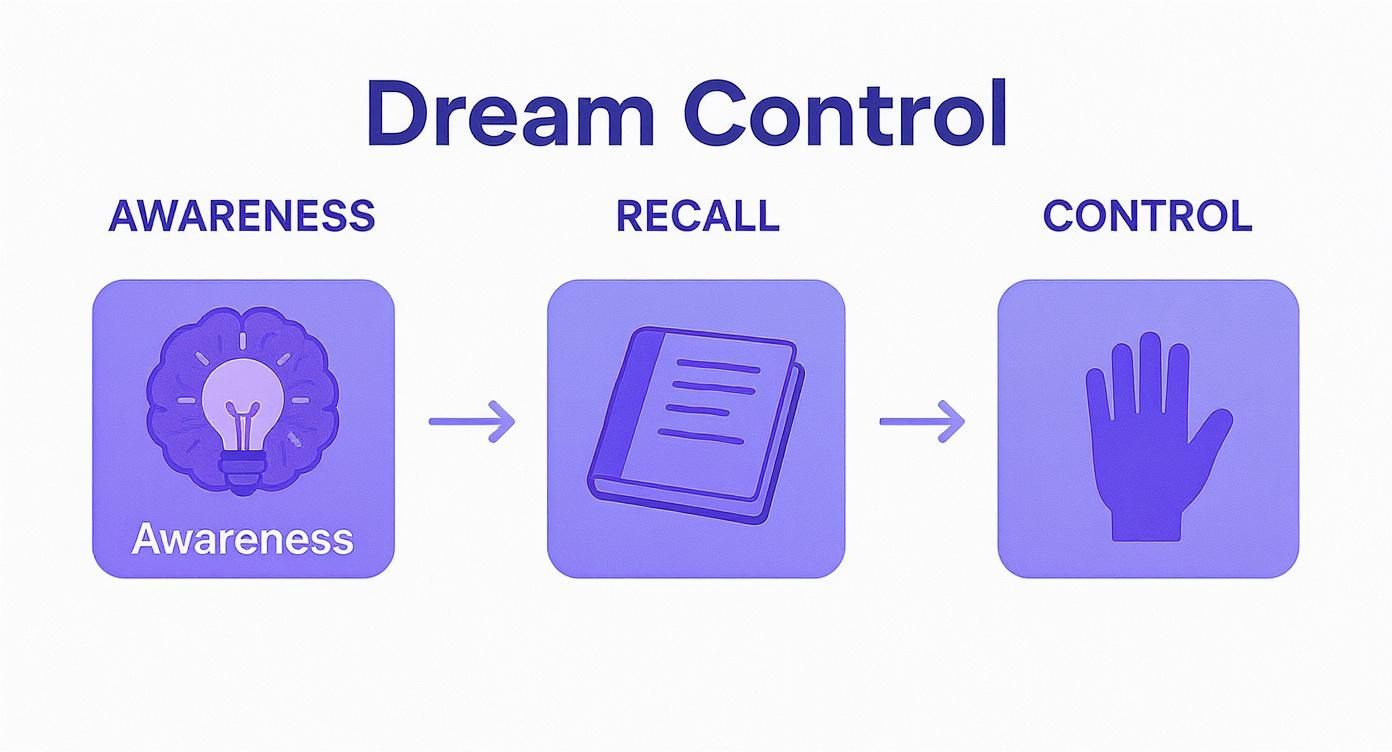
As the flowchart shows, awareness comes first, followed by the ability to recall what you've dreamt. Only then does real control become possible.
The Benefits of Conscious Dreaming
So, why would you even want to do this? The reasons are as unique as our dreams. For many, it's a powerful tool for conquering recurring nightmares. Once you become lucid in a scary dream, you can face your fears head-on, change the outcome, or even ask a menacing figure what it represents. It can turn a terrifying experience into a deeply insightful one.
Learning to guide your dreams is more than just a fun mental exercise; it's a way to engage with your inner world, boost your creativity, and practice problem-solving in a safe, imaginative space.
For others, the appeal is pure adventure. Imagine flying over mountain ranges, exploring alien planets, or practicing a new skill—all from the safety and comfort of your own mind. It’s the ultimate playground for personal growth and creativity, making your sleep feel both productive and incredibly exciting. This guide will walk you through the practical steps to start that journey.
To get you started, here's a quick cheat sheet covering the fundamental ideas and the first steps to take on your lucid dreaming journey.
Lucid Dreaming Quick-Start Guide
| Core Concept | Actionable Step | Why It Works |
|---|---|---|
| Dream Recall | Keep a dream journal by your bed. Write down everything you remember as soon as you wake up, even if it's just a feeling or a single image. | This trains your brain to prioritize dream memories, making them clearer and more accessible over time. Strong recall is the foundation for everything else. |
| State Checking | Throughout your day, ask yourself, "Am I dreaming?" and perform a simple reality check, like trying to push your finger through your palm. | Creating this habit in your waking life makes it more likely you'll do it automatically while dreaming, which can trigger lucidity. |
| Mindset & Intention | Before falling asleep, repeat to yourself, "Tonight, I will realize I am dreaming." Visualize yourself becoming aware inside a dream. | This technique, called Mnemonic Induction of Lucid Dreams (MILD), primes your subconscious to look for the signs of dreaming while you sleep. |
| Waking Awareness | Pay close attention to the sensory details of your waking life. Notice the feeling of the ground beneath your feet or the taste of your food. | Heightened daytime awareness bleeds into your dream state, making you more likely to notice the strange, illogical details that signal you're dreaming. |
Think of this table as your launchpad. Consistently practicing these simple actions is the most effective way to open the door to conscious dreaming and begin exploring your inner world.
Start with a Dream Journal to Build Your Foundation
Before you can steer your dreams, you must remember them. A dream journal is your most essential training tool. It’s more than a place to jot down notes; keeping a journal sends a powerful signal to your brain that your dreams matter and are worth holding onto. This simple act builds your dream recall—the absolute, non-negotiable first step to becoming a lucid dreamer.
When you first start, you might only remember a tiny scrap of a dream—a weird color, a random sound, a fleeting feeling. That’s perfectly normal and a great start. The key is to write it down the second you wake up. The more you do this, the more your brain gets the message. Many people who get into the habit of journaling report a huge jump in how often and how vividly they remember their dreams, sometimes in just a couple of weeks.
Keep your journal right by your bed, whether it's a physical notebook or an app on your phone. The moment your eyes open, before you even roll over or start thinking about your day, grab it and capture whatever you can. Dream memories are incredibly fragile; they can disappear within minutes.
How to Write for Maximum Recall
To turn your journal into a powerful tool, go beyond a simple summary. Try to capture the experience of the dream, as if you're right back in it. This makes the memories stick and helps your dream world feel more solid and real.
- Write in the Present Tense: Instead of, "I walked through a forest," try writing, "I am walking through a forest." This simple trick helps pull you back into the dreamscape, strengthening the memory.
- Capture All the Sensory Details: Don't just list events. What did you see, hear, or even feel? Describe the glowing moss on the trees or the sound of the wind. The more senses you engage, the more real it feels.
- Log Your Emotions: How did the dream make you feel? Excited, scared, or confused? Emotions are powerful anchors for memory and can give you important clues about the dream's meaning.
A dream journal isn’t just a record of past dreams; it’s a training ground that prepares your mind to recognize future ones. When you review your entries, you start to spot the patterns and quirks that are your personal gateways to lucidity.
Uncover Your Personal Dreamsigns
After a week or two of journaling every morning, it's time to play detective. Look for patterns in your journal entries. These recurring elements—themes, objects, people, or situations—are called dreamsigns. Spotting one of your dreamsigns while you're dreaming is one of the most reliable ways to trigger lucidity and learn how to take control.
Think of it as searching for clues in your own mind, looking for things that just don't add up in waking reality.
Your dreamsigns can be anything:
- Suddenly finding yourself in your childhood home.
- The classic dream where your teeth feel loose or fall out.
- Trying to use a phone or computer that won't work correctly.
- Seeing the same person, animal, or mythical creature repeatedly.
Once you’ve identified a few common dreamsigns, set a simple intention before sleep: "The next time I see [your dreamsign], I will realize I am dreaming." This practice transforms your journal from a simple logbook into an active training manual for lucid awareness.
Train Your Mind with Reality Checks

Now that you’re remembering your dreams more clearly, it's time for the next step: bringing that awareness into your day-to-day life. This is where reality checks come in. Think of them as quick exercises that train your brain to question whether it's awake or asleep.
The goal is simple: make this questioning so automatic that you start doing it in your dreams. When that happens, the bizarre results will be your big clue that you're dreaming, which is the magic moment that kicks off a lucid dream.
This isn't just a physical habit; it’s a mental one. You're building a bridge between your waking world and your dream world, one small question at a time.
What Makes a Good Reality Check
The best reality checks are actions that work one way in real life but go haywire in a dream. The trick isn't just doing the action. You must genuinely, with real curiosity, ask yourself, "Am I dreaming right now?"
If you just go through the motions, the habit won’t transfer to your dreams. You have to perform each check with intent, almost expecting it to fail and prove you're awake. That mindful focus is what makes the habit powerful.
Here are a few classic reality checks to get you started:
- The Palm Push: Try pushing the fingers of one hand straight through the palm of your other hand. When you're awake, your palm is solid. In a dream, your fingers will often pass right through.
- The Text Test: Glance at a digital clock, a street sign, or a page in a book. Look away, then look back. In a dream, the text or numbers will almost always be different—scrambled, weird, or complete nonsense.
- The Nose Pinch: This one is a fan favorite. Pinch your nose shut and try to breathe in. If you can still take a full, easy breath… you’re definitely dreaming.
The real power of a reality check isn't in the action itself, but in the moment of critical awareness it creates. You're teaching your mind to pause and analyze its state, a skill that's crucial for triggering lucidity.
Building the Habit Effectively
To make reality checks second nature, link them to things you already do every day. For example, decide to do one every time you walk through a doorway or each time you check your phone. Connecting a new habit to an existing one makes it much easier to remember.
This regular practice does more than just build a habit; it can actually change your brain. Studies on frequent lucid dreamers show they have stronger connections in brain regions linked to self-awareness. You’re essentially strengthening the part of your brain that helps you realize you're dreaming. If you're curious about the science, you can dig into the neuroscience of lucid dreaming on nature.com.
By questioning reality while you're awake, you're giving your dreaming mind the tools it needs to do the same. This is how you plant the seeds of awareness that will eventually bloom into your very first lucid dream.
Beginner Techniques for Dream Induction

Once you've got your dream journal and reality checks down, you're ready to start actively nudging your mind toward a lucid dream. The next step involves what are known as induction techniques. Think of them as simple yet powerful ways to tell your sleeping mind, "Hey, I want to wake up in here!"
It's all about shifting from just hoping a lucid dream happens to actively inviting one in. These beginner-friendly methods are designed to be easy to practice and won't disrupt your sleep schedule.
Set Your Intention With MILD
One of the most popular and effective starting points is the Mnemonic Induction of Lucid Dreams, or MILD technique. The name sounds technical, but the idea is incredibly simple: you set a strong intention using memory and repetition to remind your future dreaming self to become aware.
As you're lying in bed, just before drifting off, calmly repeat a simple phrase to yourself. The real trick is to make it personal and meaningful so your brain takes the mission seriously.
A few examples of MILD mantras could be:
- "Tonight, I will realize that I am dreaming."
- "The next time I'm in a dream, I will become aware."
- "I'll notice when something is odd and know it's a dream."
While you repeat your mantra, try to visualize yourself inside a recent dream. Picture the scene, then imagine yourself suddenly realizing, "This is a dream!" Feel that jolt of excitement. This powerful combo of intention and visualization is a fantastic first step in learning how to control your dreams.
This isn't just wishful thinking; it's a form of mental rehearsal. You're training your brain to recognize the dream state, which makes that spark of lucid awareness much more likely to happen.
Try a Gentle Wake Back to Bed Method
Another highly effective approach is the Wake-Back-to-Bed, or WBTB, method. While the classic version can be disruptive, a gentler take is perfect for a weekend morning when you can sleep in a little. This technique works by waking you during a period of intense dream activity (REM sleep), making your mind perfectly primed for lucidity when you fall back asleep.
Here's how to do it: set an alarm to wake you up about 90 minutes before your usual wake-up time. When it goes off, get out of bed for just 15-20 minutes. Do something quiet and relaxing—maybe read about dreams or review your dream journal.
The goal is to bring your mind to a state of gentle alertness without fully waking yourself up. After this short break, head back to bed with the clear intention of becoming lucid. You can even combine this with your MILD mantra. This technique significantly boosts your chances of entering a dream consciously because you’re returning to sleep during your brain's prime time for REM sleep.
Comparing Beginner Induction Techniques
To help you decide where to start, here's a quick look at how these two popular beginner methods stack up. Both are excellent entry points, but one might fit your style better.
| Technique | Best For | How It Works | Effort Level |
|---|---|---|---|
| MILD | Anyone, especially those who don't want to interrupt their sleep. | Setting a strong mental intention before sleep through mantras and visualization. | Low |
| Gentle WBTB | People who can afford a slight sleep interruption, like on weekends. | Waking briefly during a REM cycle to increase awareness upon returning to sleep. | Medium |
Ultimately, the best technique is the one you'll actually practice. Try one for a week, then maybe try the other. You might even find that combining them, like using MILD during a WBTB attempt, gives you the best results.
What to Do When You First Become Lucid
The moment you realize you're dreaming is a massive breakthrough. It’s an electrifying feeling, but that sudden jolt of excitement is often the very thing that kicks you right out of the dream. The secret to turning this fleeting "Aha!" moment into a stable adventure is to stay calm and immediately ground yourself within the dream world.
Your first job is to stabilize the dream before it dissolves. The best way to do this is by engaging your senses directly with the dream environment. This simple act anchors your conscious mind, keeping the whole scene from collapsing.
Stabilize Your Dream Environment
Instead of letting excitement take over, pull your focus back to the details around you. Shifting from an emotional reaction to calm observation helps solidify your presence. Think of it like dropping an anchor in choppy water—you're securing your spot so you can start exploring.
Here are a few proven techniques to try the second you become lucid:
- Rub Your Hands Together: Seriously, try it. Feel the friction and the warmth. This physical sensation is a powerful anchor that connects your conscious mind to your dream body.
- Spin in a Circle: Slowly turn around and really take in your surroundings. This can hit the reset button on a fading dream, often making it more vivid and stable.
- Verbally Announce Your Intentions: Say something out loud in the dream. A simple "Clarity now!" or "Stabilize dream!" works wonders. Your voice is an incredibly powerful tool for taking control.
The goal is to engage, not just observe. By touching, looking, and interacting with the dream world, you're sending a strong message to your brain: "I'm here, and I'm staying."
Start with Small Acts of Control
Once the dream feels solid, it’s tempting to try flying right away. But this can easily overwhelm your control and wake you up. A much better approach is to build your confidence with small, manageable acts of dream manipulation.
Start by picking a simple object nearby. Your goal is just to change one tiny thing about it. If you see a flower, try to change its color from red to blue. Just stare at it and expect the change to happen.
This experience is incredibly common, especially for younger dreamers. Research has found that while many adolescents experience lucid dreams, most don't know what to do next. You can read more about these findings on lucid dreaming across age groups. Learning these small steps gives them a clear path forward.
When you succeed with these small tasks, you build confidence and strengthen your ability to influence the dream. After you nail changing an object's color, you can move on to slightly bigger challenges, like making a small item appear in your hand. Each little victory makes the bigger feats—like flying or visiting new worlds—that much more achievable.
Common Questions About Controlling Dreams

Starting any new skill, especially one as personal as lucid dreaming, naturally brings up questions. As you start practicing, you’re bound to wonder about safety, how long it’ll take, and what to do when you hit a snag. Getting those questions answered is a huge part of building confidence and sticking with it.
Let’s tackle some of the most common things new dream explorers ask. Clearing these up will make the whole process feel less mysterious and a lot more achievable.
Is It Safe to Control Your Dreams?
Absolutely. Lucid dreaming is a completely natural and safe state of consciousness. One of the biggest fears people have is getting "stuck" in a dream, but that’s physiologically impossible. Your brain’s natural sleep cycles always ensure you wake up.
In fact, learning how to control your dreams can be an incredibly empowering tool. It's especially useful for those who deal with nightmares, giving them a way to face fears in a safe space and change a scary dream into a positive one.
How Long Does It Take to Learn This Skill?
This is one of those "it depends" answers, because everyone's timeline is unique. Some lucky folks report having their first lucid dream within a week of starting. For most people, it may take a few weeks to a month or more of dedicated practice.
Success really boils down to a few key factors:
- Consistency: Are you keeping your dream journal and doing reality checks every single day?
- Sleep Quality: Getting enough restful sleep is non-negotiable for reaching the deep REM cycles where lucid dreams most often occur.
- Mindset: Patience is your best friend. It’s about celebrating small wins, like simply remembering more of your dreams.
The key is to see this as a gradual practice, not a race to the finish line. Every step forward—from recalling a tiny dream fragment to performing a reality check in a dream—is a huge win.
Why Do I Wake Up as Soon as I Become Lucid?
This happens to almost everyone at first, so don't worry! It’s easily the most common hurdle for beginners. That sudden jolt of excitement—"Wow, I'm dreaming!"—is often so intense it shocks you awake. Your brain just isn't used to being conscious during sleep, and the surprise can break the spell.
The trick is to practice staying calm. The second you realize you're lucid, take a breath and resist the urge to get too excited. Instead, immediately ground yourself in the dream.
Focus on your senses within the dream world. Rub your hands together and really feel the friction. Spin around slowly and take in the sights. These simple actions help stabilize the dream, anchoring your awareness so you can stay longer. With practice, you’ll learn to ride that initial wave of excitement and keep the adventure going.
Are you or your young reader ready to turn dream practice into a magical adventure? The Dreams of Phillip Aisling Series brings the excitement of lucid dreaming to life through thrilling stories and relatable characters. Dive into a world where courage and imagination unlock incredible possibilities. Explore the books and companion podcast today at https://phillipaisling.com.