
Do you want to write a story with the same magic as Harry Potter? The first step is understanding its core DNA. It's built on a potent formula: a hidden magical world humming just beneath our own, the unshakable power of friendship, and a crystal-clear battle between good and evil. To capture that same lightning in a bottle, you must weave these elements into a story that feels both intensely personal and sweepingly epic.
This is the blueprint that captivated millions, and it can be yours, too.
Deconstructing the Magic of a Potter-Style Story
The magic of the Harry Potter series isn't a happy accident. It’s a masterclass in blending specific, resonant themes that grab readers by the heart. J.K. Rowling built a universe that feels both fantastical and strangely real—a quality every aspiring fantasy writer should chase. If we break down the core pieces, you'll have a practical toolkit to start brainstorming your own magical world.
And let's be honest, the success speaks for itself. The series has sold over 600 million copies worldwide, making it the best-selling in history. That kind of global phenomenon, translated into more than 80 languages, proves just how deeply these ideas connect with people everywhere. You can discover more about this literary achievement and see the staggering numbers behind the magic.
The Allure of a Hidden World
One of the most powerful hooks in Harry Potter is the idea of a secret world humming with life just beneath our own. Platform 9¾ is the perfect symbol for this—a completely ordinary spot that's actually a gateway to the extraordinary. This "world within a world" trope is an open invitation for readers to believe that magic could be real, waiting just around the corner.
As you build your own story, think about how your magical world bumps up against the ordinary one.
- Secrecy and Discovery: How is the magic kept secret? What happens when a regular person stumbles into it? This reveal is a pivotal moment for character and plot.
- Cultural Contrast: What are the funny, or even dangerous, misunderstandings between the two societies? This friction is a goldmine for both comedy and conflict.
Actionable Tip: The most compelling magical worlds aren't just places with spells; they are societies shaped by magic. The laws, culture, economy, and social norms should all feel like a direct result of wands, potions, and magical creatures being real.
The Power of Found Family
When you strip away the spells and prophecies, the story of Harry, Ron, and Hermione is about finding your people. It’s that simple. Their friendship is the emotional anchor for the entire epic saga. They are a "found family," offering the loyalty, support, and belonging that Harry desperately needed but never had.
This emotional core is what makes the stakes feel so personal, even when the fate of the entire world is hanging in the balance.
When you're crafting your characters' relationships, go for authentic bonds. Their friendship can't just be a tool to move the plot forward. It needs to be the journey, influencing their choices and pushing them to grow.
Designing a Magical School That Feels Real

Your magical school isn't just a castle on a hill; it's a living, breathing character in your story. Think about it—Hogwarts was much more than a location. It was a labyrinth of shifting staircases, forgotten rooms, and centuries of secrets that felt alive.
The goal here is to build an institution so vivid that your readers feel like they’ve just received their own acceptance letter. To do that, you need to move beyond a simple name and floor plan and give your school a soul.
Laying the Historical Foundation
Every great institution has a history. Who founded your school, and more importantly, why? Perhaps it was a circle of powerful mages seeking refuge, a single eccentric sorcerer with a wild vision, or a necessity born from a magical war.
These origin stories are goldmines for plot and character motivation. They shape your school’s core identity. A school founded to protect young magic-users from persecution will feel entirely different from one created to train elite magical soldiers. The architecture, the curriculum, even the ghosts in the hallways will reflect that founding purpose.
- Founder's Legacy: What values did the founders bake into the school's DNA? These principles should echo through its traditions, rules, and mottos.
- Key Historical Events: What major events have scarred or glorified its past? Think about legendary triumphs, tragic accidents, or bitter rivalries that still linger in the air.
Actionable Tip: A school's history provides the raw material for its legends, ghost stories, and hidden lore. These details make the world feel ancient and textured, inviting readers to explore its every corner.
Defining the School's Unique Culture
Culture is what makes your school distinct. It’s the collection of traditions, rivalries, and daily rituals that make up student life. Hogwarts had its Sorting Ceremony, House Cups, and Quidditch. What does your school have?
Think about the systems that organize the student body. Is there a house system? Are students grouped by magical aptitude, planetary alignment, or the whim of some random magical artifact? This structure is a fantastic engine for creating instant conflict and camaraderie. It forges alliances and rivalries from the moment students arrive, giving you story-driving dynamics right from page one.
Infusing the Setting with Detail
Now, let's zoom in on the specific details that make a place feel real. A magical school should be a place of wonder and unpredictability. It’s time to give it personality.
- Quirky Architecture: Does the castle rearrange itself? Do the gargoyles talk back, or do the portraits gossip about students who sneak out after curfew?
- Hidden Spaces: Every memorable school needs secret passages, forgotten chambers, or forbidden wings. These are perfect spots for clandestine meetings, thrilling discoveries, and late-night adventures.
- Magical Staff: Your teachers and staff are part of the setting, too. A grumpy groundskeeper with a secret soft spot for magical creatures or a history professor who is literally a ghost adds layers of personality to the school itself.
To help get the ideas flowing, use this table to brainstorm the core elements of your own magical school. It's a practical way to ensure you're building a world that feels both fantastical and grounded.
Magical School Design Elements
| Element | Key Questions to Ask | Example Idea (The Academy of Whispering Isles) |
|---|---|---|
| Founding & History | Who built it and why? What major events define its past? | Founded by sea mages to protect ancient ocean magic. A legendary kraken once defended it from attack. |
| Location & Architecture | Where is it? What does it look like? Does it have magical properties? | A series of floating islands connected by living bridges of coral. The central spire is carved from a single, giant pearl. |
| Culture & Traditions | How are students sorted? What are the major yearly events or competitions? | Students are chosen by sentient conch shells. The annual "Tide-Taming" festival is the main event. |
| Curriculum & Magic | What is taught? Is there a specific type of magic the school is known for? | Focuses on elemental water magic, communicating with sea creatures, and celestial navigation. |
| Secrets & Dangers | What hidden places exist? What are the forbidden zones or rumored threats? | The "Drowned Library" in the deepest part of the school is off-limits, rumored to be guarded by sirens. |
Building a magical school is an act of world-building in miniature. By focusing on its history, culture, and unique quirks, you create more than just a backdrop. You craft a place that feels real, rich, and ready for adventure—a home your characters and readers will never want to leave.
Building a Believable and Consistent Magic System

A good magic system is the engine that keeps a fantasy story running. It prevents the plot from devolving into a chaotic mess where anything can happen for no reason. If you’re serious about harry potter story writing, you must establish clear, consistent rules for how your magic works. This is essential for maintaining narrative tension and reader immersion.
The first big decision is where your magic lands on the "hard" versus "soft" spectrum. A hard magic system comes with explicit, well-defined rules, almost like a science. Think of the precise laws of alchemy in Fullmetal Alchemist. A soft magic system, on the other hand, is more mysterious and wondrous, like the subtle power wielded by Gandalf in The Lord of the Rings.
J.K. Rowling’s world is a masterful blend of both. We get the "hard" elements—wands, specific incantations, and potion ingredients are required. But the deeper magic tied to love, fate, and ancient curses feels wonderfully mysterious and "soft." Your goal is to find a similar balance for your own story.
Define the Source and Cost of Magic
Every type of magic has to come from somewhere. Is it an innate ability passed down through bloodlines? A gift from the gods? Or is it something drawn directly from the natural world itself? The source you pick will shape your entire world's culture, conflicts, and power structures.
Just as important, magic must have a cost. If your characters can fix any problem with a simple flick of the wrist, you eliminate tension. There are no stakes. Limitations are what force your heroes to be clever and create compelling conflict.
- Physical Cost: Does a massive spell drain the caster's life force or leave them utterly exhausted?
- Material Cost: Are rare, hard-to-find ingredients needed for a specific enchantment or potion to work?
- Moral Cost: Does using a certain kind of magic require a dark sacrifice or slowly corrupt the user's soul?
Actionable Tip: A magic system's limitations are often more interesting than its powers. They reveal character through the difficult choices they force and prevent magic from becoming a lazy solution to every problem.
Establish the Rules and Consequences
Once you have a source and a cost, it's time to establish the rules. How are spells learned? What can magic do? And, crucially, what can it not do? A fantastic example from the Potterverse is Gamp's Law of Elemental Transfiguration, which states you can’t create food from thin air. It’s a simple rule, but it adds a layer of realism and stakes to the world.
Whatever rules you decide on, you must stick to them. If you establish that a particular spell is forbidden and incredibly dangerous, you can’t just have a character casually use it later without a very good explanation and significant consequences. Breaking your own rules makes the world feel flimsy and erodes your reader's trust.
The global success of the series, which sold around 230 million copies in the United States alone, was built on this kind of believable world-building. Publishers even adapted the original UK text for American audiences, changing words like "jumper" to "sweater," all to keep readers immersed. To get a better sense of this strategy, you can review the impressive sales data and history.
Crafting Unforgettable Characters and Relationships
Let's be honest. The spells are cool, and a hidden magical world is exciting, but that's not what makes us fall in love with a story. The real magic of Harry Potter beats inside its characters. Harry, Ron, and Hermione are the emotional core of the entire saga, proving that the deepest magic comes from relationships that feel real.
If you’re going to write your own harry potter style story, your single most important job is creating characters that readers genuinely care about. This goes way beyond a cool name or a special talent. It means building actual people with flaws, deep-seated fears, and motivations that drive their every action.
Give Your Protagonist an Inner Conflict
Your main character needs more than just an external quest, like defeating a dark wizard. They need an internal quest, too. What’s their biggest flaw or their deepest fear? Harry’s journey wasn’t just about surviving Voldemort; it was about learning to trust other people, accept help, and realizing his greatest strength was love, not raw power.
This inner conflict is what makes a hero feel human and relatable. A perfect, fearless protagonist is boring. But a character who is brave in spite of being terrified? That’s someone we can root for.
- Define Their Core Fear: Is your hero terrified of failure? Abandonment? Not being good enough? This fear should whisper in their ear and influence their choices.
- Give Them a Major Flaw: Maybe they’re reckless, stubborn, or too quick to judge others. This flaw shouldn't be a cute quirk; it should create real problems for them and their friends.
- Establish Their Deepest Desire: What do they want more than anything else in the world? This is the engine that will propel your story forward.
Build a Dynamic Friend Group
The "Golden Trio" works so brilliantly because each member is distinct. Harry is the brave (and sometimes reckless) leader, Hermione is the brilliant strategist, and Ron is the loyal heart. They balance each other out, and their friendship is constantly put to the test, which is exactly what makes it feel so authentic.
Don't think of your main character's friends as sidekicks. They are essential parts of a team. Each one needs their own personality, skills, and personal journey. The way they interact—the arguments, the inside jokes, the unwavering support—is what breathes life into their dynamic. Their dialogue should sound different, revealing who they are through the way they speak.
Actionable Tip: The most memorable relationships are forged in fire. Don't be afraid to let your characters fight, make huge mistakes, and have to forgive each other. It’s in those moments of friction and reconciliation that their bond becomes truly unbreakable.
Craft a Villain with a Purpose
A great hero is often defined by their villain. A truly terrifying antagonist isn't just evil for the fun of it. They have their own twisted logic and motivations that make them a dark mirror of the hero. Voldemort's obsession with blood purity and immortality was the perfect dark reflection of Harry’s values of love and sacrifice.
Your villain needs to be a genuine, soul-crushing threat, not just a temporary roadblock.
- Give Them a Clear Goal: What does the villain want, and why are they so hell-bent on getting it?
- Connect Them to the Hero: Is there a shared history between them? A philosophical clash that makes their conflict deeply personal?
- Make Them Formidable: The villain must be powerful and clever enough to push your hero to their absolute limit. This is what forces your hero to grow.
By focusing on these core relationships—the hero’s internal struggle, the unbreakable bond of friendship, and the personal conflict with a meaningful villain—you build an emotional foundation that will stick with readers long after they've turned the final page.
Structuring Your Plot for Maximum Impact
A brilliant magical world and unforgettable characters are a great start, but they need a sturdy plot to hold them up. Effective harry potter story writing isn't just a random series of events; it's a carefully built structure that balances thrilling action with quieter moments of character growth. It’s what turns a collection of cool ideas into a cohesive, gripping adventure you can't put down.
The power of this kind of storytelling is staggering. The Harry Potter series spawned a multi-billion-dollar franchise, with book sales alone ringing up an estimated $7.7 billion globally. That incredible success story began with J.K. Rowling’s creative process in the early 1990s and grew into a phenomenon that proves just how much a well-structured narrative can resonate. You can read more about the franchise's incredible financial journey to see how a single story can build an empire.
This is the fundamental flow that drives a character-focused plot, taking your hero from their first introduction to the final showdown.
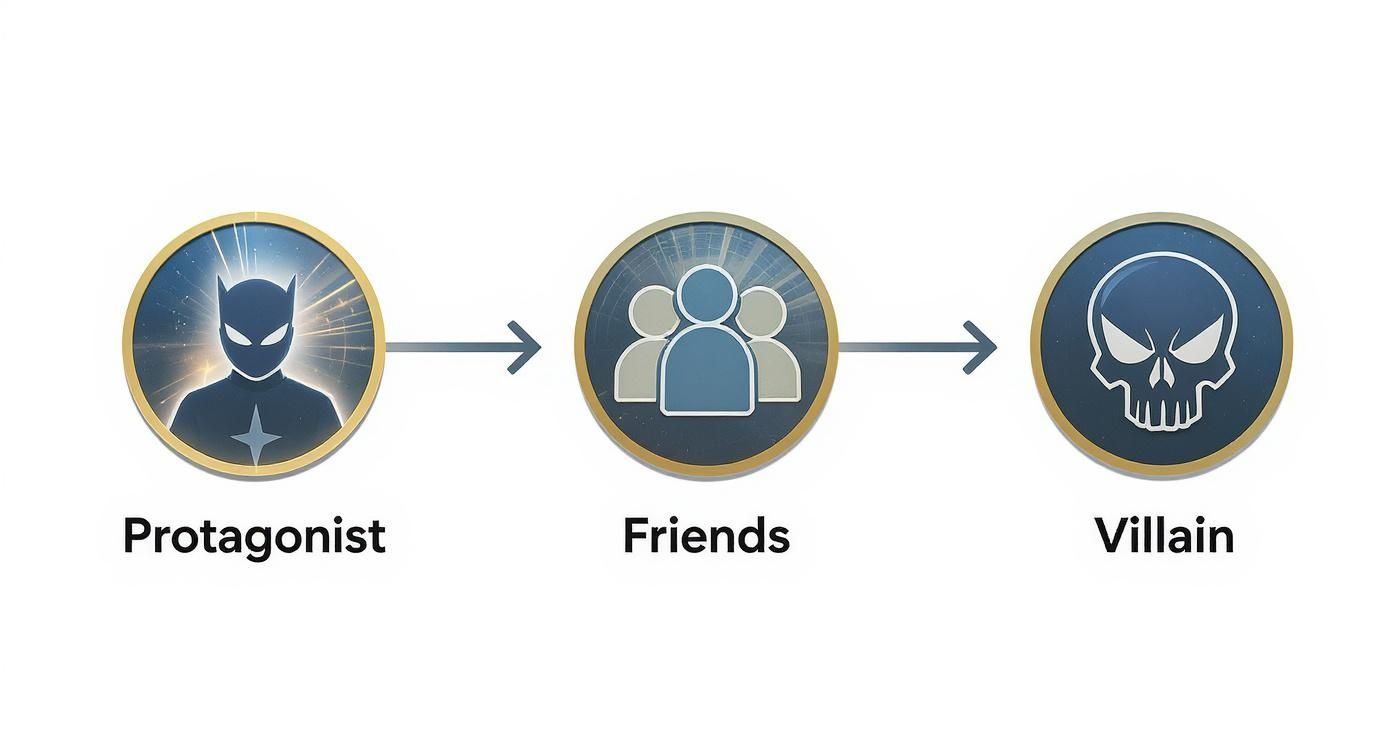
As you can see, the protagonist’s journey isn't a solo act. It's their relationships that fuel the story and lead directly to a meaningful conflict with the villain.
The Hook: The Inciting Incident
Every great story kicks off with a moment that shatters the hero’s ordinary world. For Harry, it was that first Hogwarts letter—quickly followed by a whole barrage of them. This inciting incident is the call to adventure, an event so disruptive your protagonist simply can't ignore it.
Your job is to make this moment deeply personal. It shouldn’t just kickstart the plot; it should tap into your hero’s greatest desire or deepest fear. Think about it: Harry was an unloved, neglected orphan offered a place where he finally belonged. How could he possibly say no?
Building Tension with Rising Action
Once the adventure is underway, the rising action begins. This is a series of challenges and obstacles that steadily dial up the pressure. It's where your hero learns new skills, forges alliances, and, importantly, suffers setbacks. Each event should test them in new ways, forcing them to adapt and grow.
Think of this phase as a staircase. Every step should be higher and more difficult than the one before it, pushing the plot forward while developing your characters. Some key ingredients for your rising action include:
- Introducing Subplots: Weave in secondary stories that complicate the main quest. A bitter school rivalry, a mysterious artifact, a family secret—these add layers and depth.
- Revealing Key Information: This is the time to drop clues, bits of lore, and foreshadowing that deepens the world and hints at the final confrontation.
- Raising the Stakes: Show the real consequences of failure. The threat shouldn't just be about the hero; it needs to endanger their friends, their school, or maybe their entire world.
Actionable Tip: The middle of your story isn’t just filler between the beginning and the end. It is the journey itself, where friendships are tested, secrets are uncovered, and the hero is forged into someone capable of facing the final battle.
A well-paced plot also knows when to accelerate and when to slow down. After a thrilling action sequence, give your characters—and your reader—a moment to breathe. Let them process what happened, reflect on the stakes, and strengthen their bonds. These quieter scenes make the high-stakes moments hit that much harder.
Common Questions on Writing Your Magical Story
Taking the leap into harry potter story writing is an incredible feeling, but sooner or later, every writer hits a wall. Building a world from scratch and guiding your characters through it is bound to raise some tough questions. This section tackles those common hurdles head-on, giving you practical answers to keep the magic flowing.
How Do I Avoid Overused Tropes?
We've all seen them: the "chosen one," the "wise old mentor," the dark lord lurking in the shadows. These archetypes can feel stale if you're not careful. The secret isn't to avoid them completely, but to subvert or deepen them. Give them a fresh coat of paint.
What if your "chosen one" actively wants nothing to do with their destiny? Or maybe that wise mentor isn't just selfless—they have a hidden agenda that makes their advice complicated and maybe even a little dangerous.
The key is to dig into the why. Why this particular person? What specific life events shaped your mentor's wisdom, and what personal flaws did they pick up on their journey? When you ground these familiar roles in unique motivations and complex personalities, they suddenly feel brand new.
What if My Magic System Feels Too Complicated?
It’s surprisingly easy to get tangled in the intricate web of your own magic system. You create rule after rule until even you can barely keep track. If you feel like you're drowning in details, take a step back.
Ask yourself what the reader absolutely needs to know right now for the plot to work. You don’t have to dump the entire rulebook on them in the first chapter.
Actionable Tip: Think about how J.K. Rowling handled it. She revealed the rules of her world gradually, over seven entire books. Let the rules of your magic unfold through action and consequence, not through long, dry explanations. Show us what happens when a spell backfires—that's far more interesting than just reading the rule.
How Do I Keep the Tone Consistent?
One of the things that makes the Potter series so beloved is its perfect balance of lighthearted fun and genuinely high-stakes danger. Nailing that balance is all about making sure your tonal shifts feel earned and are tied directly to your characters' emotional state.
A sudden jump from a funny scene in a potions class to a terrifying encounter in a dark corridor only works if it pushes the story forward and has a real emotional impact on your characters.
Your setting is your best friend here. A cozy, fire-lit common room naturally lends itself to humor and friendship, while a forbidden, ancient forest immediately signals suspense and peril. Let your characters’ reactions be the reader’s guide. If they can still find a reason to laugh when things look bleak, it makes their courage feel that much more authentic.
Are you ready to build a world as immersive and magical as your dreams? The Dreams of Phillip Aisling Series offers a fresh take on middle-grade fantasy, blending adventure with the fascinating concept of lucid dreaming. Dive into a story that champions courage, friendship, and the power of imagination. Start your next adventure today at phillipaisling.com.