Some children's books are more than just stories; they're gateways. They hand a child a key, not to a physical door, but to countless worlds waiting to be built inside their own mind. These powerful children's books about imagination invite young readers to explore impossible places, solve bizarre problems, and see reality from entirely new angles.
In doing so, they lay a powerful foundation for critical life skills like empathy, resilience, and abstract thinking. This guide will help you understand why these books are so important and how to choose the right ones to ignite your child's creative spark.
Why Imaginative Books Are More Than Just Stories
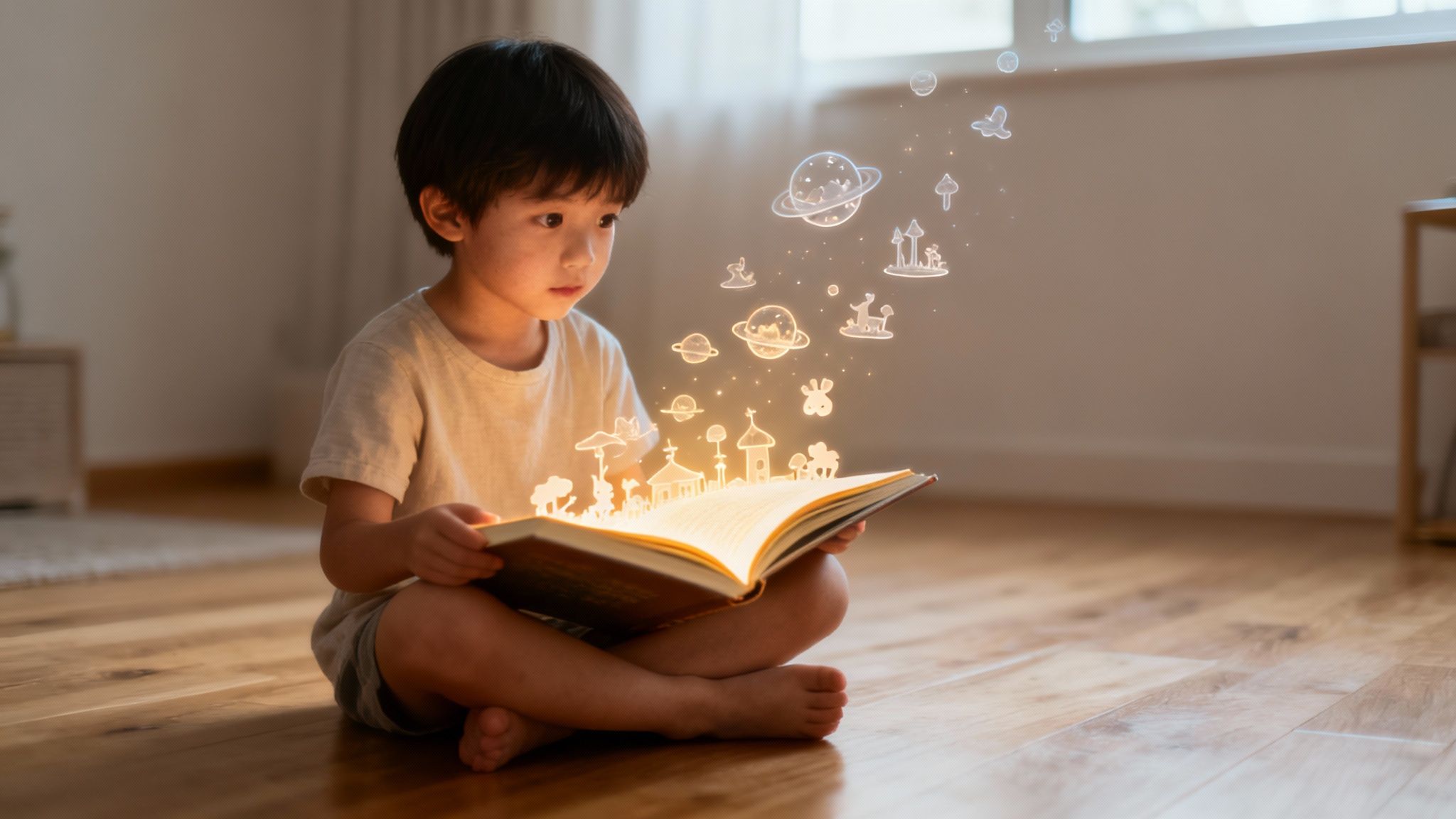
Think of these books as a workout for the brain. They strengthen the mental muscles a child needs to navigate a complex, ever-changing world. It’s not just about dragons and wizards, though those are fun, too. At their core, these stories are structured exercises in possibility.
When a child reads about a character who can talk to animals or a world where gravity works sideways, their mind has to stretch. It has to accept new rules, follow a different kind of logic, and imagine how things would work.
Building Foundational Cognitive Skills
This mental stretching is far from just fun and games. It comes with some serious developmental perks. When kids engage with stories that defy real-world limitations, they’re actually building critical thinking skills. They learn to suspend disbelief, track intricate plots, and understand cause and effect within a completely new system.
This process lays the groundwork for more advanced thinking later on. A child who can vividly picture a floating city is also a child learning to think abstractly and entertain "what if" scenarios. These are the very same cognitive pathways used for scientific discovery, artistic invention, and innovative problem-solving.
An imaginative story allows a reader to insert their own thoughts, ideas, and questions rather than simply being told what to think. It creates a space between what the words say and what the pictures show, sparking true creative engagement.
More Than Just Escape
While escaping into a good book is a wonderful thing, imaginative stories offer so much more. They function as safe laboratories where kids can explore complex emotions and tricky situations from a distance. By following characters through fantastical challenges, children can develop real-world strengths.
- Empathy: Stepping into the shoes of a character completely unlike themselves helps them understand different perspectives and feelings.
- Resilience: Watching a hero overcome impossible odds provides a powerful model for facing their own struggles, big or small.
- Creative Problem-Solving: Stories where the main character has to invent a clever solution to a magical problem teach kids to think outside the box.
Ultimately, these stories are powerful tools that equip children with the mental flexibility and emotional intelligence needed to thrive. Making children's books about imagination a core part of reading time is one of the best investments you can make in their future.
So, How Does Reading Actually Spark Your Child's Creative Genius?
The true magic of an imaginative book isn't just the story itself—it’s what that story does to a child's growing mind. Think of imagination as a muscle. The more you use it, the stronger and more flexible it gets. Every time your child dives into a story about impossible worlds and fantastical challenges, they're doing some serious cognitive heavy lifting.
This kind of mental workout forces them to suspend disbelief and wrap their heads around complex, unfamiliar rules. A world where animals talk or trees can walk isn't a passive experience; it requires active engagement. That very process builds the foundation for sharper critical thinking and the ability to grasp abstract ideas later on.
It’s a Masterclass in Empathy
Beyond the mental gymnastics, these stories are incredible tools for building emotional intelligence. When kids step into the shoes of a brave, clever, or even misunderstood character, they’re practicing how to see the world from a completely different point of view. That’s the heart of empathy right there.
Following a hero's journey—feeling their fears, understanding their motivations, and celebrating their triumphs—helps a child connect with experiences far from their own. It’s a crucial life skill, nurtured one fantastic story at a time.
And a Blueprint for Creative Problem-Solving
Imaginative books are often packed with characters who tackle seemingly insurmountable problems with pure creativity. When a hero invents a clever escape or outsmarts a magical beast, it gives kids a mental blueprint for how to solve problems in their own lives.
These stories shout from the rooftops that there isn't always one right answer. They show that thinking differently—approaching a challenge from an unexpected angle—can lead to the most brilliant solutions. This isn't just about reading a book; it's about equipping kids with the mental flexibility to innovate and adapt. The global children’s picture book market, valued at a whopping USD 4.72 billion in 2024, shows just how much parents value these developmental tools. In fact, North America alone makes up about 40% of that revenue, a clear sign of the investment in literacy that sparks imagination. You can dig deeper into these numbers by exploring the full children's picture book market analysis.
Imaginative play and storytelling aren't frivolous—they are the primary ways children learn to navigate their social and emotional worlds. Books provide the script and the characters for this essential work.
This powerful mix of brain-building and heart-building is why children's books about imagination are so vital. They don't just entertain; they build the creative, empathetic, and resilient minds our children need. By encouraging a love for these stories, you’re giving them the tools to not only understand the world but to envision how they might one day change it for the better. That’s the real genius sparked by a well-told tale.
Choosing the Right Imaginative Book for Any Age
Picking the perfect imaginative book can feel like a real head-scratcher. A story that absolutely mesmerizes a toddler with its bright colors and sing-song rhythm might not capture the attention of a ten-year-old who’s hungry for complex worlds and moral dilemmas.
The secret is to match the book to where a child is developmentally. You want the experience to be rewarding, not frustrating. Think of yourself as a literary matchmaker, connecting a kid with the one story that speaks to their current imaginative abilities while gently nudging them to grow. Get it right, and you could spark a lifelong love for creative stories.
For Toddlers and Preschoolers (Ages 1-4)
At this age, imagination is a full-body, sensory experience. Little kids are just learning the basic building blocks of storytelling through sight, sound, and touch. The best children's books about imagination for this crew don't need intricate plots.
Instead, you’re looking for a few key ingredients:
- Vibrant, Clear Illustrations: Big, bold pictures that practically tell the story on their own are a must.
- Simple "What If" Concepts: What if a lion could talk? What if a crayon could draw a door and walk through it?
- Rhythm and Repetition: A predictable, lyrical text is gold. It helps young minds follow along and feel like they're part of the story.
- Interactive Elements: Things like lift-the-flap books or pages with different textures invite kids to touch and explore, turning storytime into a hands-on adventure.
The goal here is simple: introduce the magical idea that books can be a doorway to things that don’t exist in their everyday world.
For Early Elementary Readers (Ages 5-8)
Once kids start reading on their own, their capacity for imagination takes a massive leap forward. They can now follow more structured stories and are beginning to wrap their heads around why characters do what they do. This is the prime age for stories that blend the familiar with the fantastic.
Books for this group should introduce slightly more complex ideas—think of a magical treehouse in a totally normal backyard or a regular kid who suddenly discovers they have a secret power. These stories help them see the potential for magic hiding just beneath the surface of everyday life. It’s also the perfect time to weave in moral lessons, like the importance of bravery or kindness, into fantastical plots that make those ideas stick.
This infographic does a great job of showing how reading is about so much more than just words on a page—it's foundational to a child's development in thinking, empathy, and problem-solving.
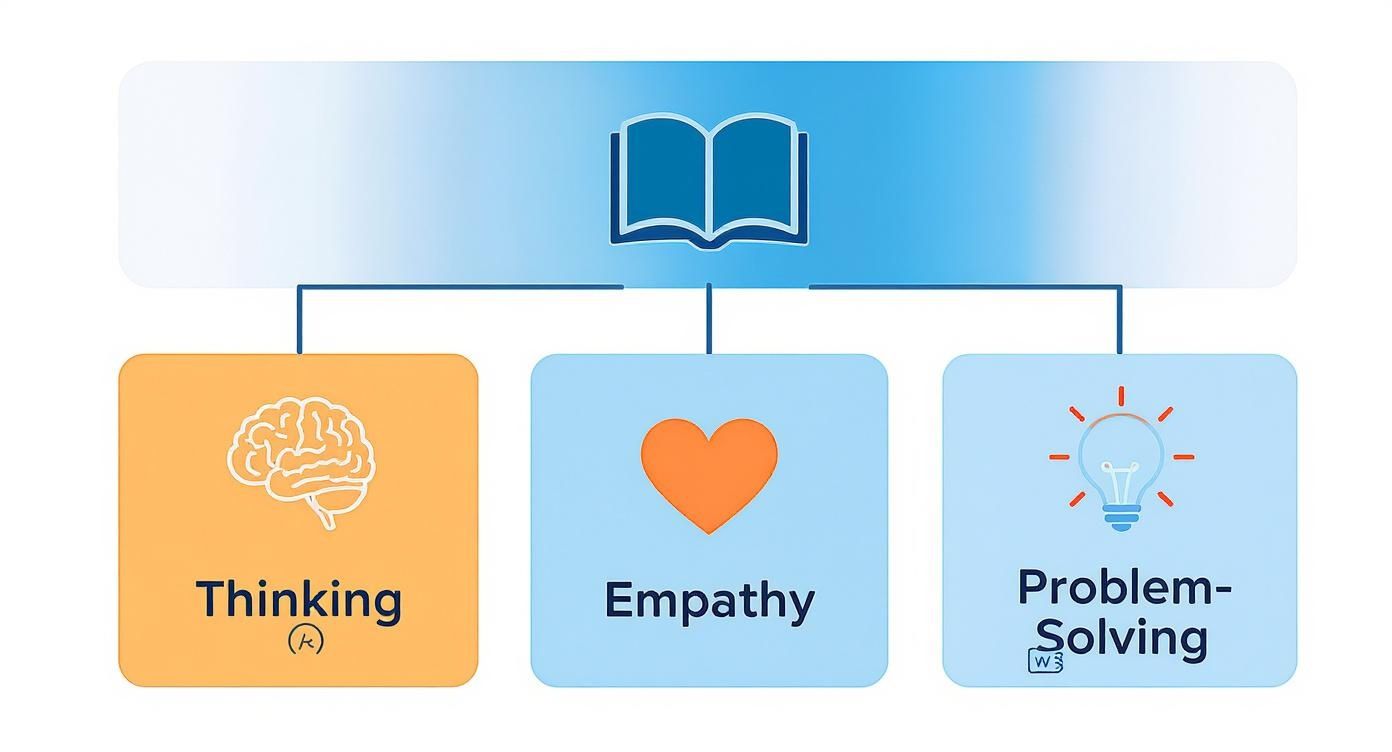
As you can see, reading isn't a single skill. It's a catalyst for building the core mental and emotional tools kids need to navigate their world.
To make selecting a book a bit easier, this table breaks down the key imaginative elements to look for across different age groups.
Age-Appropriate Guide for Imaginative Books
This table outlines key features to look for in children's books about imagination, broken down by developmental age group to help parents and educators select the perfect book.
| Age Group | Key Imaginative Elements | Example Book Concepts |
|---|---|---|
| Ages 1-4 | Sensory experiences, simple "what if" scenarios, rhythm and repetition, interactive elements. | A book about colors that come to life, animals that talk, or a magic crayon. |
| Ages 5-8 | Blending fantasy with reality, clear good vs. evil, simple moral lessons, relatable protagonists. | A secret magical world hidden in the park, a child who finds a dragon's egg, talking animal sidekicks. |
| Ages 9-12 | Complex world-building, high stakes, moral ambiguity, character-driven plots, unique magic systems. | An epic journey to save a fantasy kingdom, discovering a hidden society with its own rules, grappling with complex powers. |
Ultimately, finding the right book is about knowing the reader and giving them a world they are ready and excited to step into.
For Middle-Grade Readers (Ages 9-12)
By the time they hit the middle grades, readers are ready for truly immersive experiences. They crave intricate world-building, high stakes, and characters who face genuine moral quandaries. This is the golden age for epic fantasy series and science fiction adventures that demand their full attention and deep imaginative investment.
A great book for this age creates a space between what the words say and what the reader pictures, sparking true creative engagement. The story provides the map, but the reader builds the world in their mind.
This is where you look for books with detailed magical systems, rich histories, and characters who aren't just good or bad, but complicated. Series like The Dreams of Phillip Aisling are a perfect fit, offering readers a world with its own unique rules—in this case, the art of lucid dreaming—that they can explore right alongside the protagonists. The journey is as much about discovering the world's secrets as it is about the characters discovering themselves.
This kind of layered storytelling provides a rich, satisfying experience that empowers young readers to think critically and imagine without limits.
Bringing Stories to Life with Fun Activities
The adventure doesn't have to stop when you close the book. In fact, the last page is often the perfect jumping-off point for a whole new adventure—one where your child gets to be in the driver's seat. Turning reading from a passive activity into an active, hands-on experience is one of the best ways to forge a deeper connection with a story.
These are the moments that transform storytime into a launchpad for your child's own creativity. Instead of just consuming a narrative, they start to see themselves as creators, as world-builders. The idea is to extend the story’s magic with simple, fun prompts that don’t require anything more than a bit of curiosity.
Simple Prompts to Spark Big Ideas
You can get the ball rolling with simple, open-ended questions. The key is that there are no right or wrong answers. These questions give kids permission to really take ownership of the story and its world.
A few powerful questions to try are:
- "What happens after the last page?" This one gets them thinking about cause and effect, letting them invent a future for the characters they've just gotten to know.
- "If you could add a new character to this story, who would they be?" This is a fantastic way to explore character creation, motivation, and how one small change can ripple through an entire plot.
- "What do you think the villain was doing before the story started?" This question is brilliant for fostering empathy and helping kids realize that every character, even the "bad guy," has a backstory.
Remember, these aren't comprehension quizzes; they're invitations to play and create. You're sending a clear signal that their ideas are a valuable, welcome part of the whole experience.
From Page to Playground
For kids who love to get their hands dirty, you can pull the story right off the page and into the real world. This approach bridges the gap between the wild events in children's books about imagination and a child’s own reality, making the magic feel tangible.
Reading is just the first step. The real magic happens when a child takes the world from the page and starts to build, draw, and act it out. This is where stories become a part of who they are.
Try one of these activities after your next reading session:
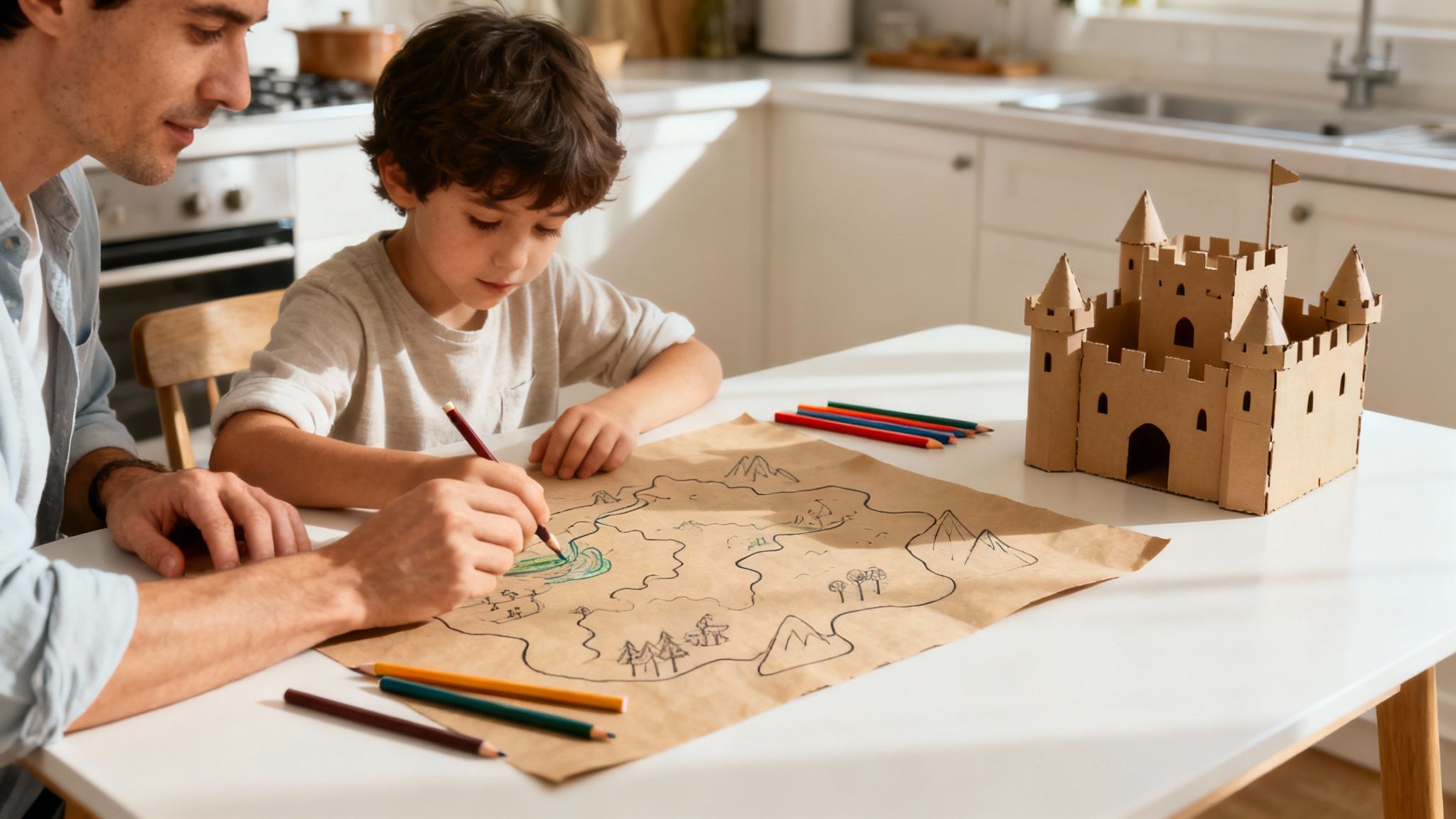
- Map the World: Grab a big sheet of paper and map out the book’s fantasy land. Add key locations, draw treacherous forests, and mark the spots where all the big moments happened.
- Invent a Gadget: If the characters used a magical object or a clever invention, challenge your child to design their own. They can draw it, build it from craft supplies, and then explain exactly how it works.
- Host a "Character Dinner": Set an extra place at the table and pretend one of the characters from the book has come over for dinner. What would you ask them? What kinds of stories would they tell?
These activities are incredibly flexible. They work just as well for a quiet afternoon at home as they do for an engaging classroom project. They empower kids, showing them that the worlds they read about are theirs to explore, expand, and even change—long after the book is back on the shelf.
Our Top Picks for Inspiring Young Minds
Ready to dive into some truly fantastic stories? Here’s a curated list of must-read children's books about imagination, each one guaranteed to spark a little wonder.
We’ve grouped them by theme to help you find the perfect adventure for your young reader.
Adventures in Unseen Worlds
These are the stories that build entire universes from scratch. They invite readers to explore places that exist only on the page and in their minds, offering intricate rules, unique cultures, and high-stakes quests that absolutely captivate middle-grade readers.
-
The Phantom Tollbooth by Norton Juster: This classic sends a bored young boy named Milo on a wild journey through the Kingdom of Wisdom. It’s a brilliant exploration of language and logic, all wrapped up in a whimsical adventure that proves knowledge is anything but dull.
-
The Dreams of Phillip Aisling Series: This is a perfect next step for readers ready to go deeper. The series explores the fascinating world of lucid dreaming, giving a unique framework for the imagination. The main characters learn to navigate and shape their own dreamscapes, blending thrilling adventure with powerful lessons on courage and self-discovery.
Finding Magic in the Everyday
Not every imaginative story needs an epic fantasy setting. Some of the most powerful tales find extraordinary magic hiding in the most ordinary places.
These books teach kids to see their own world with fresh, curious eyes. They're perfect for showing that imagination is a tool you can use anywhere, anytime.
A truly great imaginative book doesn’t just show a reader a new world; it gives them a new lens through which to see their own. It whispers that magic isn't somewhere else—it's right here, if you know how to look.
This ability to find wonder in the familiar is a skill that lasts a lifetime. And the demand for these kinds of creative stories is huge. In 2022, fantasy was the leading genre, making up an estimated 35% of children's book sales worldwide. Picture books alone accounted for roughly 60% of those sales. This trend shows a strong, sustained interest in books that actively nurture creativity. You can learn more about the growth of imaginative children's literature.
Stories That Celebrate Invention and Creation
These books are all about the power of making something out of nothing. They celebrate the inventors, the artists, and the dreamers who look at a blank page or a pile of scraps and see infinite possibility.
They are perfect for inspiring kids to become creators themselves.
-
Harold and the Purple Crayon by Crockett Johnson: A simple but profound story about a little boy who draws his entire world into existence with a single purple crayon. It’s the ultimate tribute to creative agency, showing that with a bit of imagination, you can create your own path.
-
The Most Magnificent Thing by Ashley Spires: This book follows a young girl determined to build a "magnificent thing." It's a realistic and inspiring look at the creative process—complete with frustration, failure, and the ultimate triumph of bringing an idea to life. It’s a beautiful illustration of how making mistakes is a vital part of invention.
Got Questions About Sparking Imagination? We've Got Answers
Even with the best intentions, figuring out how to use books to kickstart a kid's imagination can feel tricky. It's totally normal to wonder if you're getting it right or picking the best stories. Let's clear up a few of the most common questions so you can feel confident you're making reading a powerful creative force.
We’re here to give you practical, straightforward answers that build on everything we’ve talked about.
How Can I Engage a Child Who Prefers 'Real-Life' Stories?
This comes up a lot. Some kids are just wired for non-fiction or stories that feel true-to-life. The trick isn't to force them into epic fantasies, but to find the imaginative spark inside what they already love. Think of it like building a bridge from what they know to what’s possible.
If your child is obsessed with animals, try a story where the animals talk. If they love big construction sites, maybe a book about a magical building that puts itself together. You start right where their passion is and gently nudge the boundaries by asking, "What if?" This respects their taste while still giving those imaginative muscles a workout. It shows them creativity isn't just for far-off lands; it’s right here in the real world, too.
The goal isn't to replace realistic stories with fantasy. It is to show that imagination is a way of thinking that can be applied to any topic, from science and history to magical kingdoms.
This gradual approach helps them understand that children's books about imagination aren't some separate, weird genre, but a different lens for looking at everything.
Are Digital Interactive Books as Good as Physical Ones?
A big question now that screens are everywhere. Interactive e-books can absolutely be incredible tools. With games, animations, and sound effects, they can pull a child into a story in a way that feels immersive and participatory.
The market for these books is booming for a reason. Valued at about USD 2.18 billion in 2024, it's expected to more than double by 2035. That kind of growth shows just how effective they can be at blending tech with storytelling. You can get more details on the rise of interactive children's literature on wiseguyreports.com.
But the experience is different. A physical book fosters a quieter, more internal kind of imagination. The child has to supply the sound effects and picture the action in their own mind, which is a powerful cognitive exercise. Honestly, the best approach is probably a healthy mix of both. Let them get the best of digital engagement and the unique brain-building of a traditional book.
What Is the Right Balance Between Fantasy and Reality?
Finding that perfect balance isn't about hitting a specific ratio. It's more about tuning into a child's developmental stage and what they're drawn to at the moment. Fantastical stories are essential for building abstract thinking and creative problem-solving skills. They literally teach kids to see beyond the world they know.
On the other hand, realistic stories are their anchor. They help kids make sense of their own world, their relationships, and their place in it. A healthy reading diet really needs both.
Think about these points to find your own balance:
- Watch for their cues. If a kid seems a little lost or overwhelmed by a complex fantasy world, switch back to a grounded, realistic story for a bit.
- Connect the two. After you finish a fantasy book, talk about how the feelings in it—courage, fear, friendship—are the exact same feelings we have in real life.
- Alternate genres. Get in the habit of mixing things up. Follow an epic quest with a quiet story about a day at the park.
At the end of the day, both kinds of stories are working together, building an imaginative, empathetic, and well-rounded reader.
Ready to jump into a world that strikes that perfect balance between thrilling adventure and deep discovery? The Dreams of Phillip Aisling Series is your next great read. Explore the books, have a listen to the podcast, and sign up for our newsletter to get updates and special offers. Start your journey into the world of lucid dreaming today.