Finding the perfect book that captures a middle schooler's imagination can feel like a quest in itself. Fantasy offers a unique portal to worlds of magic, courage, and limitless possibility, making it a powerful genre for readers navigating the pivotal years between ages 11 and 14. This curated guide is designed to help parents, educators, and young readers discover their next great adventure. We’ve assembled a detailed list of the best fantasy books for middle schoolers, moving beyond simple summaries to offer genuine value.
This list is more than just a collection of titles. For each book, you will find:
- A concise blurb capturing the story's essence.
- Why it resonates specifically with middle-grade readers.
- Practical ideas for classroom use or family book club discussions.
- Crucial content notes to help you make informed choices.
- Carefully selected read-alikes to keep the journey going, including dream-weaving tales like The Dreams of Phillip Aisling Series.
From epic quests and magical schools to intricate new worlds, our goal is to provide a comprehensive resource. You’ll find everything you need to connect young readers with stories that will inspire and entertain them long after the final page is turned.
1. Percy Jackson & the Olympians: The Lightning Thief
Rick Riordan’s The Lightning Thief is a masterclass in modern mythology, making it one of the best fantasy books for middle schoolers. The story follows twelve-year-old Percy Jackson, a sarcastic and relatable protagonist who discovers he is the son of the Greek god Poseidon. After being accused of stealing Zeus’s master lightning bolt, Percy embarks on a cross-country quest to find the real thief, clear his name, and prevent a catastrophic war among the gods.

This fast-paced adventure brilliantly blends ancient Greek myths with contemporary American life, featuring everything from gorgons in a garden gnome emporium to a gateway to the Underworld in a Los Angeles recording studio. Percy’s journey is packed with humor, action, and heartfelt lessons about friendship, loyalty, and embracing one's own unique identity.
Why It’s a Great Fit
This book is a fantastic gateway for young readers into the world of classical mythology. Riordan makes complex myths accessible and exciting, weaving them into a story that addresses common middle-grade challenges like feeling out of place and discovering personal strengths. The narrative is driven by a witty, first-person voice that immediately connects with its target audience.
- Reading Level/Age Range: Ages 10-14, Grades 5-9
- Content Notes: Fantasy violence and mythical monsters. Mild thematic elements of family conflict and betrayal.
- Classroom/Family Use: Excellent for introducing units on Greek mythology. Use a character map to track the gods, goddesses, and monsters Percy encounters. Discuss how ancient stories are reinterpreted in modern settings.
- Read-Alikes: The Kane Chronicles by Rick Riordan, The Dreams of Phillip Aisling Series, and Aru Shah and the End of Time by Roshani Chokshi.
2. The Golden Compass (Northern Lights)
Philip Pullman’s The Golden Compass (published as Northern Lights in the U.K.) is a landmark of fantasy literature, making it one of the best fantasy books for more mature middle schoolers. The story introduces Lyra Belacqua, a fiercely independent girl living in a parallel version of Oxford. Her world is turned upside down when her friend is kidnapped, leading her on a journey to the Arctic to uncover a sinister conspiracy involving stolen children and a mysterious cosmic substance called Dust.
This profoundly imaginative novel is famous for its concept of dæmons: physical manifestations of a person’s soul that take the form of an animal companion. Lyra’s quest is filled with armored polar bears, secretive Magisterium officials, and flying witches, all set against a backdrop of stunningly detailed world-building. The narrative is a rich and challenging adventure that explores deep themes of courage, free will, and the fight against oppressive authority.
Why It’s a Great Fit
This book is perfect for advanced middle-grade readers ready to tackle more complex philosophical themes. Pullman’s prose is beautiful and sophisticated, offering a story that respects the intelligence of its young audience. The concept of dæmons provides a unique and powerful way for readers to explore ideas of identity, consciousness, and the human soul.
- Reading Level/Age Range: Ages 12+, Grades 7-9
- Content Notes: Complex themes of institutional corruption, moral ambiguity, and philosophical concepts. Some intense fantasy violence and character deaths.
- Classroom/Family Use: Ideal for discussing symbolism and allegory. Explore the concept of dæmons by having students or family members discuss what animal their soul might be and why. Use it as a springboard for conversations about authority and morality.
- Read-Alikes: The Giver by Lois Lowry, The Dreams of Phillip Aisling Series, and The Bartimaeus Sequence by Jonathan Stroud.
3. Harry Potter and the Sorcerer's Stone
J.K. Rowling’s Harry Potter and the Sorcerer's Stone is the book that launched a global phenomenon, and its timeless magic makes it one of the best fantasy books for middle schoolers. The story introduces eleven-year-old Harry Potter, an orphan living a miserable life with his cruel relatives. His world is turned upside down when he discovers he is a wizard and receives an invitation to attend Hogwarts School of Witchcraft and Wizardry. Harry is thrust into a world of enchanted castles, powerful spells, and enduring friendships as he uncovers the truth about his past and confronts the dark forces that seek to return.
This enchanting novel is a masterful blend of mystery, adventure, and coming-of-age themes. It builds an incredibly detailed and immersive magical world that has captivated readers for decades. From the thrill of a Quidditch match to the warmth of the Gryffindor common room, the story is filled with wonder and heart, exploring profound ideas about courage, love, and choosing what is right.
Why It’s a Great Fit
This book is a perfect introduction to epic fantasy, teaching readers about world-building, character arcs, and thematic depth. It resonates deeply with middle schoolers by tackling universal feelings of being an outsider, discovering one's true potential, and the vital importance of friendship. The compelling mystery at its core keeps readers hooked while they become invested in the fates of Harry, Ron, and Hermione.
- Reading Level/Age Range: Ages 9-12, Grades 4-7
- Content Notes: Fantasy peril and some scary scenes involving mythical creatures and a villain's return. Themes of loss and orphanhood are central.
- Classroom/Family Use: An ideal series for a read-along. Discuss the defining traits of the four Hogwarts houses and ask students or family members which house they would belong to. Compare the book to the film adaptation to analyze narrative choices.
- Read-Alikes: The Dreams of Phillip Aisling Series, The School for Good and Evil by Soman Chainani, and Nevermoor: The Trials of Morrigan Crow by Jessica Townsend.
4. A Darker Shade of Magic
V.E. Schwab’s A Darker Shade of Magic introduces readers to a stunningly original multiverse, making it a top choice for more mature middle schoolers ready for a complex fantasy. The story follows Kell, one of the last Antari, magicians with the rare ability to travel between parallel Londons: Red, Grey, White, and the lost Black London. When a dangerous artifact from the forbidden Black London falls into his hands, Kell is forced to team up with Delilah Bard, a cunning thief from magic-less Grey London, to save all worlds from a corrupting magical force.
This novel is a brilliant blend of portal fantasy and political intrigue, built on a detailed and fascinating magic system. Kell’s journey across the different Londons is filled with high-stakes adventure, morally grey characters, and sharp dialogue. The world-building is immersive, painting a vivid picture of each unique city and the powers that govern it.
Why It’s a Great Fit
While often categorized as adult fantasy, its fast-paced plot, accessible prose, and compelling protagonists make it an excellent pick for advanced middle-grade readers. The story introduces themes of power, responsibility, and the nature of good and evil, offering plenty of material for deeper discussion. It serves as a perfect bridge into the world of urban fantasy and more complex character dynamics.
- Reading Level/Age Range: Ages 13+, Grades 8-10
- Content Notes: Fantasy violence, some intense and dark magical sequences. Characters face morally ambiguous choices.
- Classroom/Family Use: Compare and contrast the four parallel Londons using a Venn diagram or chart. Discuss the moral complexities of characters like Kell and Lila and whether their actions are justified.
- Read-Alikes: Six of Crows by Leigh Bardugo, The Dreams of Phillip Aisling Series, and Vicious by V.E. Schwab.
5. Howl's Moving Castle
Diana Wynne Jones’s Howl's Moving Castle is an enchanting and whimsical tale that has captivated readers for decades, earning its spot as one of the best fantasy books for middle schoolers. The story follows Sophie Hatter, the eldest of three sisters, who is cursed by a witch and transformed into an old woman. Her only hope of breaking the spell leads her to the magical, ever-moving castle of the flamboyant and notorious Wizard Howl.

Inside, Sophie strikes a bargain with a fire demon named Calcifer and becomes the castle’s cleaning lady, navigating a household filled with chaotic magic and Howl's dramatic antics. The novel is a delightful blend of humor, romance, and adventure, exploring themes of self-perception, inner beauty, and the courage to define your own destiny. Jones’s witty prose and inventive worldbuilding create a truly unforgettable experience.
Why It’s a Great Fit
This book is perfect for middle schoolers who appreciate character-driven stories with a strong, witty voice. Sophie’s journey from a quiet, resigned girl to a feisty, assertive woman is inspiring and relatable. The story beautifully balances its lighthearted, comical moments with deeper emotional threads about self-worth and found family, offering a sophisticated yet accessible read.
- Reading Level/Age Range: Ages 10-14, Grades 5-9
- Content Notes: Mild fantasy peril. Thematic elements include curses and dealing with self-image.
- Classroom/Family Use: Compare the novel to the popular Studio Ghibli film adaptation to discuss storytelling choices across different media. Analyze Sophie’s character development and how her external appearance affects her internal confidence.
- Read-Alikes: The Girl Who Drank the Moon by Kelly Barnhill, The Dreams of Phillip Aisling Series, and Ella Enchanted by Gail Carson Levine.
6. The Spiderwick Chronicles: The Field Guide
Tony DiTerlizzi and Holly Black’s The Field Guide is a beautifully illustrated introduction to a world of faeries hiding just out of sight, making it one of the best fantasy books for middle schoolers. The story introduces the Grace siblings—Jared, Simon, and Mallory—who move into the dilapidated Spiderwick Estate. There, they uncover a secret library and a mysterious book: Arthur Spiderwick’s Field Guide to the Fantastical World Around You, which catalogs the goblins, sprites, and other fae that live unseen in the modern world.
This first entry in a five-book series masterfully blends a contemporary family drama with classic faerie lore. The book's short length and intricate illustrations make it incredibly accessible, pulling readers into a mystery as the siblings learn that their newfound knowledge makes them a target for dangerous magical creatures. It’s an adventure that feels both wondrous and thrillingly close to home.
Why It’s a Great Fit
The combination of narrative text with detailed, scrapbook-style illustrations offers a unique and immersive reading experience. The story’s central mystery and fast-paced plot are perfect for keeping young readers engaged, while the themes of family, bravery, and the consequences of forbidden knowledge provide depth. The series is a brilliant entry point into folklore and classic fantasy for readers who may be intimidated by longer novels.
- Reading Level/Age Range: Ages 8-12, Grades 3-7
- Content Notes: Mild fantasy peril and mischievous or menacing creatures. Thematic elements include family conflict and dealing with parents' separation.
- Classroom/Family Use: An excellent series for reluctant readers due to its brevity and visual appeal. Have students create their own "field guide" page for a real or imagined creature, mimicking the style of the illustrations.
- Read-Alikes: Fablehaven by Brandon Mull, The Dreams of Phillip Aisling Series, and The Girl Who Drank the Moon by Kelly Barnhill.
7. The Name of the Wind
Patrick Rothfuss’s The Name of the Wind offers a sophisticated and lyrical journey, making it a stellar choice for more advanced middle school readers. The novel is framed as a story within a story, where the legendary Kvothe recounts his early life as a gifted young arcanist at a prestigious magical university. He details his struggles with poverty, his intense rivalries, and his relentless pursuit of forbidden knowledge.
While often shelved in the adult fantasy section, its themes of ambition, friendship, and self-discovery resonate deeply with mature young adults. The book is celebrated for its intricate magic system based on sympathy and naming, and its beautiful, almost poetic prose. This is a story that rewards patience and careful reading, immersing its audience in a richly detailed world.
Why It’s a Great Fit
For older or more advanced middle school readers, this book provides a challenging yet immensely rewarding experience. It introduces complex narrative structures, like an unreliable narrator, and a deep, philosophical magic system. The university setting provides a familiar backdrop for a story about finding your place, excelling against the odds, and dealing with complex social dynamics.
- Reading Level/Age Range: Ages 13+, Grades 8-9 (best for mature readers)
- Content Notes: Some violence, thematic elements of poverty, loss, and mild romantic tension. The complexity of the prose and themes may be challenging for younger readers.
- Classroom/Family Use: An excellent choice for discussing the concept of an unreliable narrator. Encourage readers to track Kvothe’s achievements versus his own narration. Discuss the novel’s intricate world-building and magic system.
- Read-Alikes: A Wizard of Earthsea by Ursula K. Le Guin, The Dreams of Phillip Aisling Series, and Eragon by Christopher Paolini.
8. Wings of Fire: The Dragonet Prophecy
Tui T. Sutherland’s The Dragonet Prophecy launches a sprawling epic told entirely from the perspective of dragons, solidifying its place among the best fantasy books for middle schoolers. The story introduces five young dragons, each from a different warring tribe, who have been raised in secret to fulfill a mysterious prophecy. When they escape their captivity to find their own destinies, they are thrown into a world of political intrigue, ancient secrets, and shifting allegiances.
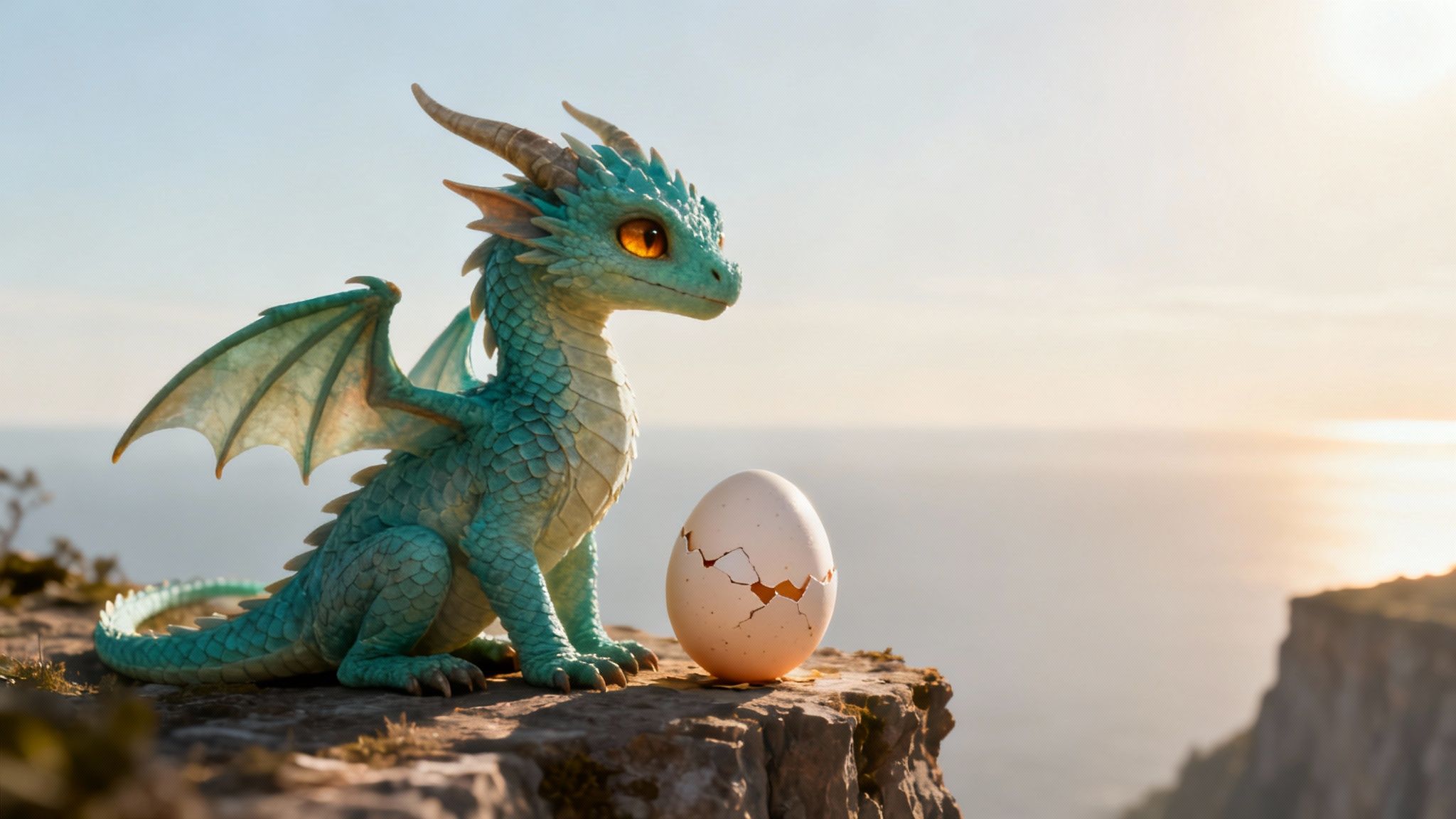
This first book in the massively popular Wings of Fire series offers a unique and immersive reading experience by focusing on a complex dragon society. The fast-paced plot is driven by themes of fate versus free will, found family, and understanding different perspectives. Readers will quickly become invested in the distinct personalities of the five dragonets as they navigate a dangerous and wonderfully imagined world.
Why It’s a Great Fit
This series is perfect for readers who love deep worldbuilding and character-driven stories. By shifting the point-of-view character in each book, Sutherland explores complex social dynamics and prejudice in a way that is accessible to middle-grade audiences. The high stakes and constant sense of adventure make it a page-turner that encourages empathy and critical thinking.
- Reading Level/Age Range: Ages 8-12, Grades 3-7
- Content Notes: Fantasy violence (dragon combat) and some moments of peril. Themes of war and prejudice are central to the plot.
- Classroom/Family Use: An excellent series for discussing perspective-taking, as each book in the first arc is told by a different dragonet. Create a chart to track the various dragon tribes, their abilities, and their political conflicts.
- Read-Alikes: Warrior Cats by Erin Hunter, Guardians of Ga'Hoole by Kathryn Lasky, and The Dreams of Phillip Aisling Series.
9. A Wrinkle in Time
Madeleine L'Engle's Newbery Medal-winning classic, A Wrinkle in Time, is a timeless science-fantasy novel that has captivated middle schoolers for generations. The story centers on the fiercely intelligent and endearingly awkward Meg Murry, who embarks on an interdimensional journey to rescue her missing physicist father. Aided by her gifted younger brother Charles Wallace and their friend Calvin O'Keefe, Meg travels through space and time via a "tesseract," confronting a universe-spanning darkness.
This profound adventure blends complex scientific theories with deep philosophical questions about conformity, love, and free will. L'Engle's narrative is a powerful exploration of light versus darkness and the idea that one's perceived flaws can actually be their greatest strengths. Its unique combination of science fiction and fantasy makes it an essential and one of the best fantasy books for middle schoolers seeking a thought-provoking read.
Why It’s a Great Fit
This book is perfect for readers who appreciate a more introspective and philosophical journey. It challenges young minds to think about abstract concepts while rooting the story in the relatable struggles of its protagonist, Meg. The novel's celebration of individuality and the power of love to overcome evil provides a powerful and enduring message for middle-grade readers navigating their own identities.
- Reading Level/Age Range: Ages 10-14, Grades 5-9
- Content Notes: Thematic elements of good vs. evil, conformity, and peril. Some scenes involving a disembodied brain and mind control may be unsettling for younger readers.
- Classroom/Family Use: Excellent for discussions on themes of individuality vs. conformity. Explore the scientific concepts mentioned, like the tesseract. Compare the 1962 novel with its more recent film adaptations to analyze storytelling choices.
- Read-Alikes: The Giver by Lois Lowry, When You Reach Me by Rebecca Stead, and The Dreams of Phillip Aisling Series.
10. The Cruel Prince
Holly Black’s The Cruel Prince plunges readers into the treacherous and glittering world of Faerie, making it a compelling fantasy book for older middle schoolers. The story centers on Jude Duarte, a mortal girl who was stolen away to live in the High Court of Faerie. Surrounded by powerful, immortal beings who despise mortals, Jude fights for a place in a world where she is seen as weak, navigating intricate court politics and a dangerous rivalry with the wicked Prince Cardan.
This dark fantasy is a masterwork of political intrigue and complex character development. Jude's ambition and resilience drive a narrative filled with deception, shifting alliances, and shocking betrayals. Black’s worldbuilding is lush and immersive, reimagining faerie lore with a modern, sophisticated edge that has captivated a new generation of fantasy readers.
Why It’s a Great Fit
Perfect for mature middle-grade readers transitioning to young adult fiction, this book offers a more complex plot and morally gray characters. It challenges readers to think about power, ambition, and what it means to belong. The intricate political maneuvering and Jude’s fierce determination provide a sophisticated and engaging reading experience that respects the intelligence of older readers.
- Reading Level/Age Range: Ages 13+, Grades 8-10
- Content Notes: Fantasy violence, bullying, and mature political themes including betrayal and assassination. Best suited for older, more mature readers.
- Classroom/Family Use: An excellent choice for discussing character morality and political strategy. Use a relationship web to track the shifting allegiances between characters in the Faerie court. Discuss Jude’s difficult choices and whether the ends justify the means.
- Read-Alikes: An Ember in the Ashes by Sabaa Tahir, The Dreams of Phillip Aisling Series, and Six of Crows by Leigh Bardugo.
Top 10 Middle School Fantasy Books — Comparison
| Title | Best For Ages | Key Themes | Why It's a Top Pick ⭐ |
|---|---|---|---|
| Percy Jackson & the Olympians: The Lightning Thief | 10-14 | Identity, Friendship, Mythology | Fast-paced, humorous, and a brilliant gateway to mythology. |
| The Golden Compass (Northern Lights) | 12+ | Free Will, Authority, Morality | Deeply imaginative with complex philosophical themes for advanced readers. |
| Harry Potter and the Sorcerer's Stone | 9-12 | Friendship, Courage, Good vs. Evil | An iconic, immersive world that defines the magical school genre. |
| A Darker Shade of Magic | 13+ | Power, Consequence, Parallel Worlds | A sophisticated and thrilling bridge to adult urban fantasy. |
| Howl's Moving Castle | 10-14 | Self-Worth, Found Family, Destiny | Whimsical, witty, and character-driven with a heartwarming core. |
| The Spiderwick Chronicles: The Field Guide | 8-12 | Family, Discovery, Folklore | Highly accessible and visually engaging, perfect for reluctant readers. |
| The Name of the Wind | 13+ | Ambition, Storytelling, Knowledge | A masterpiece of lyrical prose and intricate world-building for mature readers. |
| Wings of Fire: The Dragonet Prophecy | 8-12 | Fate, Prejudice, Perspective | A unique, dragon-centric epic that explores complex social issues. |
| A Wrinkle in Time | 10-14 | Individuality, Love, Science vs. Faith | A timeless classic that blends science fiction and fantasy with deep themes. |
| The Cruel Prince | 13+ | Power, Ambition, Belonging | A dark, political fantasy with a fierce protagonist and high-stakes intrigue. |
Your Next Adventure Awaits
The journey through the pages of a book is one of the most powerful adventures a young reader can take. From the demigod training grounds of Camp Half-Blood to the whimsical, walking castle of a mysterious wizard, we have explored a universe of stories designed to captivate and challenge the middle-grade mind. Each title on our list was chosen not just for its magical elements but for its ability to connect with readers on a deeper level, offering them windows into new worlds and mirrors reflecting their own experiences.
The goal of this guide was to provide more than just a list of the best fantasy books for middle schoolers; it was to create a roadmap. By organizing books by theme, providing clear age recommendations, and offering discussion prompts, we hope to have empowered parents, educators, and young readers to make intentional choices that foster a genuine and lasting love for reading.
Key Takeaways for Your Reading Quest
Remember that the "best" book is always the one that resonates most with an individual reader. To help you find that perfect match, keep these core principles in mind:
- Match the Book to the Reader: Consider your middle schooler's current interests, reading level, and emotional maturity. A book like The Spiderwick Chronicles might be perfect for a younger reader ready for fantasy, while a more complex narrative like The Golden Compass offers a rich challenge for an older, more advanced reader.
- Embrace Conversation: The magic doesn't end when the book is closed. Use the discussion questions provided for each entry to talk about themes of courage, friendship, and morality. These conversations build critical thinking skills and help young readers process complex ideas in a safe, supportive environment.
- Look Beyond the Obvious: While classics like Harry Potter are foundational, the world of middle-grade fantasy is vast and diverse. Encourage exploration of newer series like Wings of Fire or mind-bending standalone novels like A Wrinkle in Time to broaden their literary horizons.
Ultimately, the power of fantasy literature lies in its ability to do more than just entertain. It builds empathy by asking readers to step into someone else’s shoes, it sparks curiosity about history, mythology, and science, and it empowers them to imagine a world where anything is possible. By providing a curated selection of the best fantasy books for middle schoolers, we hope to have opened a door to a lifetime of discovery. Your next great adventure is out there, waiting between the covers of a book.
If your reader was particularly captivated by the imaginative worlds, coming-of-age journeys, and themes of self-discovery found in this list, they will love the adventure in The Dreams of Phillip Aisling Series. This series is a perfect next step for fans of intricate world-building and character-driven fantasy. Explore the series and download free resources at The Dreams of Phillip Aisling Series.