
Finding the perfect adventure books for 10 year olds can feel like its own grand quest. But it’s worth the effort. The right story is more than just a fun way to pass an afternoon—it’s a powerful tool for building resilience and sparking a genuine, lifelong love for reading.
A truly thrilling book isn’t just entertainment. For a 10-year-old, it’s a lived experience that lights up their curiosity and courage, providing a safe space to explore challenges and discover their own inner strength.
Why Adventure Stories Are So Important at This Age
Ten is a fascinating age. Kids are really starting to figure out who they are, their friendships are getting more complex, and they’re looking at the big, wide world with new eyes. Adventure stories give them a safe space to practice for all the big life lessons headed their way. It’s a training ground for courage, problem-solving, and empathy, all from the comfort of a cozy beanbag chair.
These stories are more than just exciting plots. They’re maps that help kids learn to navigate their own challenges. When a character gets knocked down and gets back up, the reader learns a little something about perseverance. When a group of friends has to puzzle out a mystery together, the reader sees teamwork in action.
Building Real-Life Skills, One Chapter at a Time
A great adventure book does so much more than just improve a child’s reading comprehension. It helps build the foundation for a curious, resilient, and thoughtful person. The benefits are huge:
- It fosters resilience. Characters who fail but keep trying teach kids that setbacks are just part of the journey, not the end of the road. This lesson—that failure is not final—is a critical component of developing a growth mindset.
- It encourages critical thinking. Piecing together clues in a mystery or figuring out why a character is acting a certain way helps sharpen those analytical skills. Readers learn to look for patterns, make inferences, and evaluate information—skills that are essential both in and out of the classroom.
- It sparks a global curiosity. Stories set in faraway lands or incredible fantasy worlds open up a child’s mind to different cultures, ideas, and possibilities, fostering a sense of wonder about the world beyond their own backyard.
- It builds empathy. Stepping into a character's shoes is the best way for a 10-year-old to understand perspectives and feelings that are different from their own, teaching them to consider the "why" behind others' actions.
The Ever-Growing World of Adventure
It’s a great time to be a young reader. The world of children's literature is exploding with amazing stories, and it's clear that people understand how important these books are. In fact, the global market for interactive children’s books, already valued at USD 2.48 billion, is expected to more than double by 2035. This isn't just about flashy tech; it shows that our appetite for grand adventures is stronger than ever. You can dig into these market trends yourself through recent industry analysis.
"A book is a dream that you hold in your hand." – Neil Gaiman
Neil Gaiman really nailed it. For kids this age, that's exactly what an adventure story is. It's not just words on a page; it’s a portal to another world. It’s a chance for them to go on incredible journeys, face down a few imaginary dragons, and discover the hero they have inside themselves.
This guide is your compass for finding those game-changing stories that will not only entertain but also empower your young reader.
Matching the Book to Your Young Explorer
So, how do you figure out if an adventure book is the perfect fit, beyond the age range printed on the back? Choosing the right book is a lot like picking a hiking trail for a family outing. You wouldn't drag a first-timer up a sheer cliff face, but you also don't want a path so flat it's boring. The magic is in finding that sweet spot—a story that offers a thrilling challenge without being completely overwhelming.
This is where you become a book-matching expert. We’re going to look past the simple age guidelines and get into the real substance of the story, helping you find a reading journey that genuinely clicks.
H3: Decoding Reading Levels and Complexity
First, let's get the technical stuff out of the way. You’ve probably seen reading level systems like Lexile scores or grade-level markers. These are handy for getting a quick read on sentence length and vocabulary, but they absolutely do not tell the whole story. A book can have simple, straightforward language but tackle some surprisingly complex emotional ideas.
Think of these systems as the "trail difficulty" rating on a map. They’re a great starting point, but you still need to consider the "terrain"—the actual content of the story. A book with a lower reading level might still be the perfect adventure book for 10 year olds if the plot is gripping and the ideas are big enough to chew on.
H3: Gauging Thematic Maturity
This is where your gut feeling as a parent or educator is priceless. Thematic maturity is that "terrain" we just talked about—the emotional and ethical landscape the characters have to cross. You know your kid better than any algorithm ever will.
When you're sizing up a new book, keep these things in mind:
- Level of Peril: How real does the danger feel? Are the heroes up against cartoonish bad guys, or are the threats genuinely unsettling? A story where someone narrowly escapes a collapsing cave hits differently than one where a character faces lasting, realistic harm.
- Moral Complexity: Is it a simple case of good versus evil, or are characters stuck between a rock and a hard place with no easy answers? A 10-year-old is often more than ready for stories that live in the gray areas, and that’s where the best conversations happen.
- Emotional Depth: Does the story wade into heavy topics like loss, betrayal, or serious fear? Adventure stories are fantastic for building empathy, but you want to make sure the emotional weight of the book matches your child's readiness to carry it.
This decision tree gives you a simple way to think through whether a book will land well, starting with what piques their curiosity and moving on to how it might build their resilience.
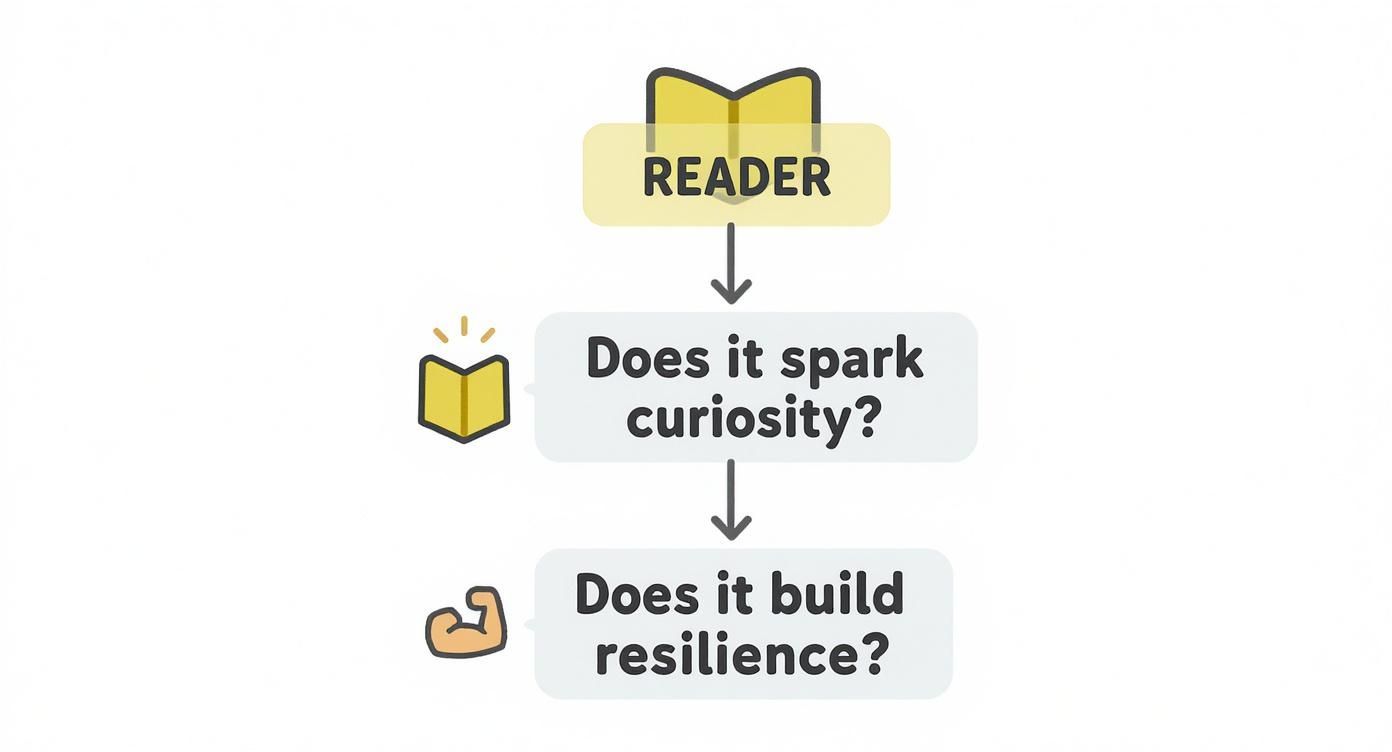
At the end of the day, the best books for this age are the ones that ignite their imagination while also giving them a chance to grow a little stronger.
To make this process a bit easier, here's a quick checklist you can use to evaluate any book you're considering.
Quick Guide to Assessing Book Suitability for a 10-Year-Old
| Assessment Factor | What to Look For | Example Clue |
|---|---|---|
| Pacing & Plot | A clear, engaging plot that moves along steadily. Are there long, descriptive lulls that might lose their interest? | Flip to a random chapter. Does the action or dialogue pull you in within a page or two? |
| Character Relatability | Protagonists who face challenges a 10-year-old can understand, even in a fantasy setting. | The main character is struggling with a friendship fallout or feels like an outsider. |
| Emotional Stakes | The challenges feel significant but not traumatic. Does the story handle fear or sadness in a constructive way? | A beloved pet is lost but is eventually found, teaching a lesson about responsibility. |
| Vocabulary Stretch | The language includes some new words but isn't so dense that it requires a dictionary for every page. | The text introduces words like "treacherous" or "ingenuity" within a clear context. |
| Resolution & Hope | The ending feels earned and satisfying, even if it’s not perfectly happy. Does it leave the reader feeling empowered? | The heroes don't win everything, but they grow stronger and learn who their true friends are. |
This isn't about finding a "perfect" book, but about finding the right book for your reader right now.
H3: Finding the Just-Right Challenge
The ideal adventure story nudges a reader just past their comfort zone, both in their reading skill and their emotional understanding. That’s the space where real growth happens. A book that’s too easy can feel patronizing, but one that’s too hard is a one-way ticket to frustration.
The goal is to find a story that stretches their world without breaking their confidence. It should feel like an achievable quest, one that leaves them feeling proud and capable once they've turned the final page.
Look for a smart balance. A book with trickier vocabulary might be a great choice if the plot is straightforward and zips along. On the flip side, a story with deep emotional themes might be perfect for a strong reader if the language itself is simple and clear. By looking at both the "trail rating" and the "terrain," you can pick adventures that build skills and spark a genuine love for reading.
Charting the Worlds of Adventure Subgenres

"Adventure" is a massive umbrella, covering a thousand different worlds and a million different thrills. Think of it like a giant buffet; there's a flavor for every palate, and the secret to getting a kid hooked on reading is finding the exact dish they'll devour. This section is your map to those literary territories, with big, friendly signposts pointing the way.
Once you know what makes each subgenre tick, you can skip the generic recommendations and find the specific kind of story that will have your 10-year-old sneaking a flashlight under the covers to read just one more chapter. Let's explore the most popular realms.
The Realm of High Fantasy
This is the big one. High Fantasy is the land of sprawling worlds, deep magic, and quests of legendary proportions. We're talking mythical beasts, ancient prophecies, and everyday kids discovering they have an extraordinary destiny. For a 10-year-old, this stuff is pure, uncut escapism.
The real magic here is the boundless imagination. Readers aren't just tagging along with a hero; they're learning the rules of an entirely new reality. How does the magic work? What's the history behind these warring kingdoms? This is what makes the genre so incredibly immersive.
- What it offers: Epic stakes, clear-cut battles between good and evil, and the absolute thrill of discovering a secret, magical world hidden just beyond our own.
- A great fit for: Kids who love mythology, daydream about having special powers, and crave stories that feel truly larger than life.
Series like The Dreams of Phillip Aisling are perfect entry points, dropping young readers into worlds where the impossible is just another Tuesday, all while modeling courage and creative problem-solving.
The Final Frontier of Science Fiction
If fantasy builds worlds with magic, Science Fiction uses the bricks of technology, innovation, and a whole lot of "what if?" This subgenre blasts readers into the future, across the galaxy, or through alternate dimensions. The action here centers on futuristic gadgets, alien encounters, and voyages to the stars.
What makes sci-fi so potent for this age group is how it marries thrilling action with big ideas. A story about exploring a new planet can secretly be a story about courage, protecting our environment, or what it truly means to be human. It’s an adventure that stretches the mind right alongside the imagination, pushing kids to think about the future and their place in it.
A great science fiction story doesn't just show us the future; it asks us to think about how we'll get there. It transforms complex scientific concepts into compelling human drama, making abstract ideas feel personal and exciting.
The Intrigue of a Great Mystery
Mystery offers a completely different kind of adventure—one that’s interactive and mentally engaging. Instead of fighting dragons or flying starships, the reader becomes a detective, challenged to piece together clues, sniff out red herrings, and crack the case right alongside the heroes.
A good mystery is an active experience. Ten-year-olds are in a prime spot for this, as their critical thinking and logic skills are firing on all cylinders. Every chapter is a new piece of the puzzle, inviting them to form theories and make predictions. It’s a story and a game all in one.
- Key Elements: A central question or crime to solve, a clever protagonist (or a team of friends), and a trail of clues that leads to a truly satisfying "aha!" moment.
- Perfect for: Curious kids who love puzzles, notice the little details, and get a huge kick out of figuring things out for themselves.
The Grit of Realistic Survival
Hey, not all grand adventures need magic wands or spaceships. Realistic Survival stories throw characters against the most powerful foe of all: nature. These stories are all about resourcefulness, resilience, and raw courage in the face of being lost in the wilderness, surviving a storm, or just enduring the elements.
The appeal here is primal. These stories tap into a deep-seated curiosity about what we're made of. For a 10-year-old, reading about a character learning to build a shelter or find food is both empowering and genuinely educational. It shows them that heroism isn't just about big battles; it's also about quiet determination and smart thinking.
These tales are often some of the most inspiring adventure books for 10 year olds because they showcase the strength of the human spirit in a way that feels totally real and achievable.
Even in these realistic tales, illustrations make a huge difference. The children’s picture book market is valued at over USD 12 billion for a reason—visuals are a powerful part of storytelling. For older kids, this can translate to illustrated survival guides or graphic novels that mix captivating images with text, building both confidence and literacy. You can dig into the market's growth in this detailed report on the children's book industry.
By exploring these different flavors of adventure, you’re sure to find the one that will turn reading from a chore into your child’s next great obsession.
Your Essential Adventure Reading List
Alright, we've mapped out the different territories of adventure fiction. Now it's time to pack the essentials. Think of this list as your personal treasure chest, overflowing with some of the very best adventure books for 10 year olds.
I've organized these recommendations by the subgenres we just talked about, so you can zero in on the perfect story for your young reader's unique taste. Each book summary gets right to the heart of the quest and highlights big themes like courage, friendship, and clever problem-solving. This is your go-to guide for your next trip to the library or bookstore.
And speaking of bookstores, there's still something magical about them. Even with tablets and e-readers, roughly 55% of children's book sales still happen in those brick-and-mortar shops. There's a real power in the tactile feel of a book and the community vibe of a local store. You can read more about the lasting impact of physical bookstores on the children's publishing market.
High Fantasy Adventures
These are the stories that whisk readers away to other worlds—places where magic is woven into the fabric of reality, destinies hang in the balance, and epic quests are just waiting for a hero. If your kid loves mythology and daydreams about discovering their own hidden powers, these are for them.
-
The Dreams of Phillip Aisling Series by Jonathan L. F. Oake
- The Adventure: Phillip Aisling thinks he’s just a normal kid until he discovers he’s a lucid dreamer, able to consciously explore and even shape his own dream worlds. He soon learns he isn't alone. Phillip must find his way through a hidden society of dreamers, uncovering ancient secrets while facing off against shadowy figures who want to twist the power of dreams for their own dark agenda.
- Why It's a Great Choice: This series is a fantastic blend of real-world kid problems and boundless, fantastical dreamscapes. It's a truly empowering story that digs into creativity, finding your courage, and understanding your own mind. You can jump into this incredible world by exploring the series at PhillipAisling.com.
-
Percy Jackson & The Olympians The Lightning Thief by Rick Riordan
- The Adventure: Twelve-year-old Percy Jackson's world is turned upside down when he learns he's the son of Poseidon, the Greek god of the sea. As if that's not enough, he's accused of stealing Zeus's master lightning bolt. To clear his name and stop a war between the gods, he has to embark on a wild, cross-country quest to find the real thief.
- Why It's a Great Choice: Riordan has a knack for making ancient mythology feel completely modern and thrilling. Percy's journey is smart, funny, and filled with non-stop action and genuine friendship.
Science Fiction Expeditions
For the young explorer fascinated by gadgets, the final frontier, and what the future might hold, these sci-fi tales offer mind-bending journeys to the stars and beyond.
- The City of Ember by Jeanne DuPrau
- The Adventure: For generations, the people of Ember have lived in a city of permanent twilight, their only light coming from a massive, aging generator. But now, the generator is failing. Two friends, Lina and Doon, stumble upon fragments of an ancient message that might just be their only way out of a dying city and into a world they can't even imagine.
- Why It's a Great Choice: It’s a masterful mix of post-apocalyptic adventure and gripping mystery. The book builds suspense beautifully, making you feel like you're solving the puzzle right alongside the characters while exploring themes of hope and human ingenuity.
A great sci-fi story for this age isn't just about cool gadgets; it's about how people use them to solve big problems. It encourages kids to think critically about the future and their own potential to make a difference.
Thrilling Mysteries and Puzzles
These books turn reading into an interactive game, making your child the detective. If you have a curious kid who loves putting clues together and shouting "Aha!", these are the perfect fit.
-
The Westing Game by Ellen Raskin
- The Adventure: Sixteen total strangers are named as heirs in the will of the eccentric millionaire Samuel W. Westing. But there's a catch: they're all players in a bizarre game. The prize? A $200 million inheritance for whoever can solve the puzzle of his death.
- Why It's a Great Choice: This Newbery Medal winner is a masterclass in mystery writing. Its tangled plot, wonderfully weird characters, and clever wordplay will challenge and thrill any 10-year-old who loves a good mental workout.
-
Greenglass House by Kate Milford
- The Adventure: Milo, the adopted son of the owners of a smugglers' inn, is just hoping for a quiet Christmas vacation. His plans are dashed when a whole crew of strange guests arrives, each with a secret connection to the old house. Milo and his friend Meddy have to unravel a mystery that's been hiding within the inn's walls for years.
- Why It's a Great Choice: The story is incredibly atmospheric, creating a setting that's both cozy and full of suspense. It’s a fantastic mystery that also gently explores what it means to find your own identity and family.
Realistic Survival Challenges
No magic wands or spaceships here. These adventures are all about characters facing the raw, unforgiving power of nature. They are perfect for readers who admire stories of grit, resourcefulness, and the incredible strength of the human spirit.
- Hatchet by Gary Paulsen
- The Adventure: After his single-engine plane crashes in the Canadian wilderness, 13-year-old Brian Robeson is completely alone. With only the clothes on his back and a hatchet his mother gave him, he must learn to survive, facing down his own fears and the brutal realities of the wild.
- Why It's a Great Choice: An absolute classic for a reason. Hatchet is a powerful, unforgettable story of survival and self-reliance. It’s one of those books that sticks with you long after you finish it, teaching deep lessons about perseverance and finding strength you never knew you had.
Keeping the Adventure Alive After the Last Page
The last sentence of a great adventure book can feel like a door slamming shut. One minute you're deep in a thrilling world with characters you love, and the next—it's over. But the magic doesn't have to evaporate just because the book is closed. Think of the story as a launchpad for conversations that bring the adventure roaring right back into your living room.
When you turn reading from a solo mission into a shared experience, you deepen its impact. Talking about a book together isn't just a comprehension quiz; it’s how you help your young reader forge connections between the story’s big ideas and their own life. It’s how fictional courage can spark real-world confidence.
Igniting Meaningful Conversations
The trick to a great book chat is to ask open-ended questions—the kind that can't be answered with a simple "yes" or "no." Instead of "Did you like it?" try something like, "What was the bravest thing a character did, and why do you think they did it?" That little shift invites real reflection and a much more personal response.
Your role here is more of a fellow explorer than a quizmaster. The goal is to wonder with them. These chats help a 10-year-old unpack complex themes, see things from another's point of view, and start to figure out their own values.
Here are a few go-to prompts that work for almost any adventure book for 10 year olds:
- If you could give the main character one piece of advice at the start of their journey, what would it be?
- Which character changed the most from the beginning of the story to the end? How did they change?
- Was there a decision a character made that you totally disagreed with? What would you have done instead?
- If this story had a different ending, what do you think might have happened?
Exploring the World of Phillip Aisling
Jumping into a specific series like The Dreams of Phillip Aisling opens up some really cool discussion topics, especially with its themes of imagination, courage, and the power of the mind. The whole idea of lucid dreaming is a goldmine for sparking incredible conversations.
"A book is a dream that you hold in your hand," Neil Gaiman once wrote. This is literally the heart of the Phillip Aisling series, making it the perfect playground for talking about that blurry line between our inner worlds and outer realities.
After finishing a chapter or a whole book in the series, you could try these tailored questions:
- If you could control your dreams like Phillip, what’s the very first adventure you would create for yourself?
- The series talks a lot about facing your fears inside dreams. Do you think being brave in a dream could make you braver in real life? Why or why not?
- Phillip has to learn to trust his friends in the dream world. Why is teamwork so important on his adventures?
These discussions aren't just for fun. They help kids connect the dots between a character's journey and their own growth. By talking through Phillip's choices, a young reader learns to think more critically about their own decisions, building empathy and self-awareness one chapter at a time. The adventure really does continue long after the final page is turned.
Your Questions on Kids Adventure Books Answered
Picking the right books for middle-grade readers can feel like a quest in itself. As a parent or educator, you're bound to run into a few common hurdles. I’ve gathered some of the most frequent questions that come up and answered them here to help you guide your young reader with confidence.
How Can Adventure Books Help a Reluctant Reader?
Adventure books are pure magic for pulling in a reluctant reader. Why? Because they're almost always fast-paced and plot-driven. That forward momentum grabs a child's attention immediately and keeps them flipping pages just to see what happens next. The clear goals and high stakes in an adventure story are often far more gripping than a slower, more character-focused story might be.
If you're looking for a starting point, try a series with a killer hook, an adventure-themed graphic novel, or even a book tied to a movie they already love. That feeling of accomplishment after finishing a genuinely thrilling story can be all the motivation they need to pick up the next one.
Are There Adventure Books Not Too Scary for a Sensitive Child?
Absolutely. Not every adventure has to be a life-or-death situation. The trick is to look for adventures with "lower stakes." Think of mystery-adventure series where the focus is on clever problem-solving rather than heart-pounding peril. Realistic adventure stories about exploration or navigating friendships can also be fantastic choices.
Keep an eye on reviews from trusted sources, as they often flag scenes that might be too intense. Ultimately, you want stories that celebrate teamwork, courage, and ingenuity over violence and conflict. This way, the thrill comes from the journey itself, not from being scared.
Finding the right book is about matching the story's emotional weight to your child's readiness. The goal is to build excitement and confidence, offering a challenge that empowers them without causing anxiety.
How Can I Find More Diverse Adventure Books?
It’s easier now than ever to find diverse adventure books for 10 year olds, and doing so is one of the best ways to broaden their horizons. A great place to start is with titles that have won awards celebrating diversity in literature, like the Coretta Scott King Award or the Pura Belpré Award.
Websites like "We Need Diverse Books" offer fantastic, curated reading lists that do the hard work for you. When you search on your own, get specific: look for adventure stories featuring different cultures, unique mythologies, or main characters with diverse abilities and family dynamics. It’s not just about representation—it’s about enriching your child’s world with incredible new stories.
What if My Child Only Wants to Reread the Same Series?
First off, rereading is a great sign! It shows a deep, genuine love for a story, and it's an amazing way to build reading fluency and confidence. Instead of seeing it as a rut, think of it as a bridge to their next favorite book.
To gently nudge them toward something new, try finding "read-alikes." Ask them what they love so much about their favorite series. Is it the intricate magic system? The unbreakable friendships? The brain-twisting mysteries?
Once you know what hooks them, you can find other books with similar themes. You could try saying, "Since you love the magic in that series, you might really enjoy this new book where the characters have totally different kinds of powers!" This approach validates what they already love while opening the door to their next great adventure.
Ready to dive into a world where dreams hold the key to adventure? The Dreams of Phillip Aisling Series offers a unique fantasy journey that blends real-world challenges with the limitless power of imagination. Start the adventure today at phillipaisling.com and discover a story that will spark creativity and courage in your young reader.